For US, EU, and other destination-market importers buying ground RC vehicles through a factory or trading supplier, accept a case-pack reply only when the vehicle set, pack counts, and carton measurements describe the same revision. A double-sided 4WD stunt car and a 1:64 rear-wheel-drive car with a trailer need separate packing references, not a shared “RC car” carton entry. Use this RC vehicle wholesale case-pack planning test to advance a consistent reply, clarify omissions, or hold unresolved contradictions.
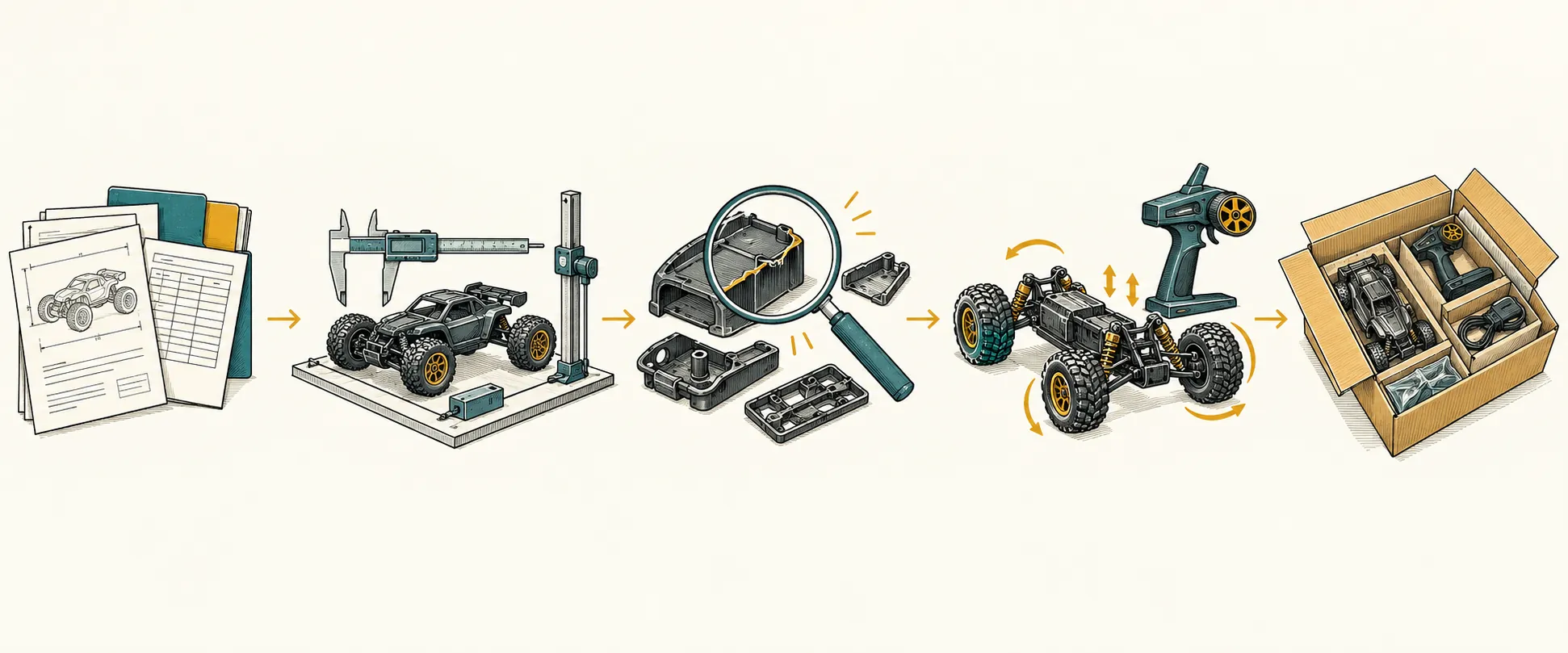
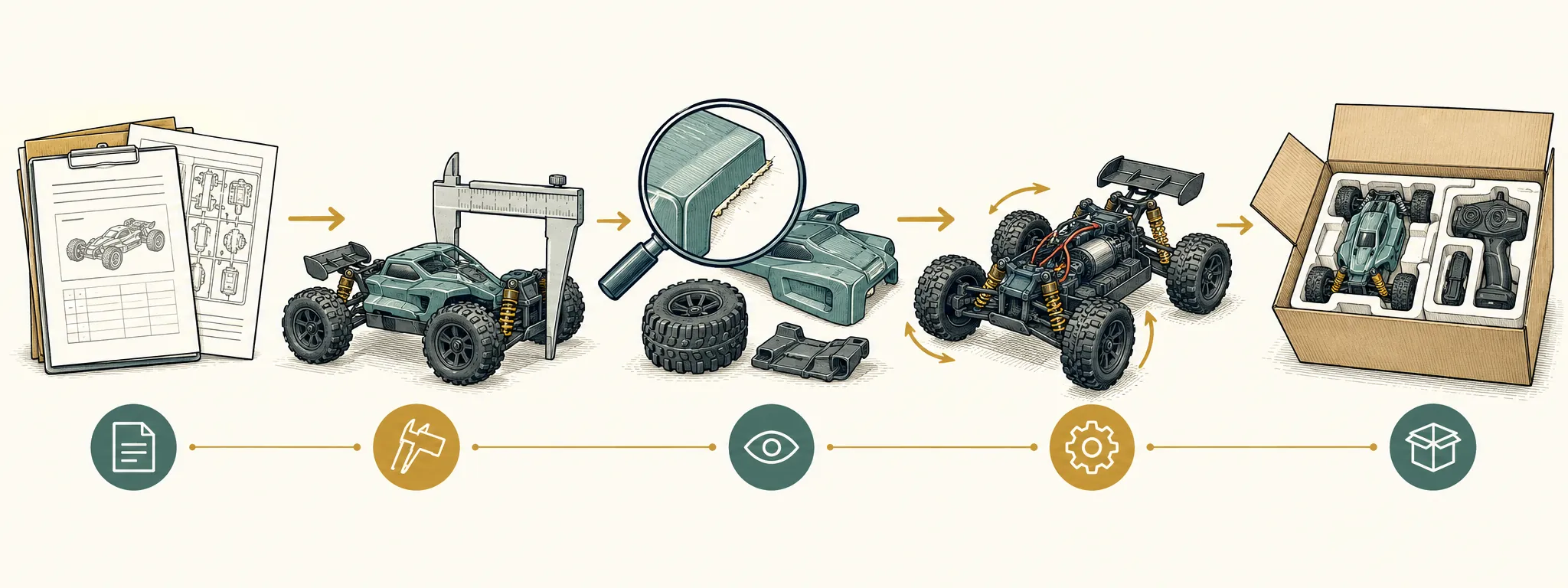
Which vehicle and selling unit must the supplier identify?
Require the supplier to identify one complete sellable set before comparing carton quantities. “Pieces” can otherwise mean vehicles, retail boxes, or complete sets—and a trailer must not quietly become a second saleable unit.
Keep the stunt-car and miniature car-and-trailer references separate in the assortment. Their mechanisms identify different products; their actual packed configurations must establish their respective case packs. Do not transfer a carton specification between them because both are ground RC vehicles.
| Double-sided 4WD 2.4GHz RC stunt car — CTF-1600917438511 | Match the reply to the double-sided, four-wheel-drive vehicle. Request a current vehicle photo, the supplier's item reference, and an itemized retail-set contents list covering the controller and any included power or charging accessories. The packing reference must identify this exact set and variant. |
|---|---|
| 1:64 RWD RC car with trailer — CTF-352238 | Treat the car-and-trailer configuration as its own reference. Require the supplier to define whether one counted unit is a complete retail set, identify the controller and included accessories, and show the trailer's packed position. Do not accept a car-only packing record as the basis for the trailer set. |
What should you request, and which responses are acceptable?
Apply the same six checks to every supplier: identity, count structure, assortment, dimensions, weight, and packing configuration must reconcile for one named revision. These are proposed purchasing acceptance criteria, not safety standards or measured predictors of supplier performance.
State the destination country and your receiving requirements in the request. If a retailer requires a fixed assortment or a particular carton label, identify that as the buyer's requirement—not a universal rule.
| Vehicle identity and revision | Request: buyer and supplier item references, vehicle/set photos, variant, pack revision, and reply date. Acceptable response: the quotation, packing sheet, and photos identify the same vehicle and retail-set contents. Record: a dated packing sheet with linked photo references. Clarify an unmapped supplier code; hold the case-pack approval if the photos and documents identify different vehicles. |
|---|---|
| Master-carton and inner-pack counts | Ask for complete retail sets per master carton, inners per master, and sets per inner; allow an explicit statement that there are no inners. Accept when the inner structure reconciles with the stated master total. Keep an annotated packing layout or count sheet. An omitted inner-pack description needs clarification; incompatible totals need correction before carton planning advances. |
| Variant assortment and replenishment | Specify whether the carton is single-variant or mixed, then request the quantity of each variant. Accept when the variant quantities reconcile with the master total and match the requested assortment. Record the agreed assortment by revision and ask whether reorders will retain it. A reply offering an alternative mix is a commercial proposal to evaluate, not automatically an error. |
| Packed dimensions | Request external master-carton length, width, and height in centimeters, plus retail-pack and inner-pack dimensions where applicable. Accept clearly identified measurements for the same configuration, supported by a layout or packed-carton photos. Clarify dimensions with no measurement basis. Resolve an apparent fit problem through the actual arrangement; volume arithmetic alone does not establish that boxes fit. |
| Net and gross carton weight | Require weights in kilograms and a definition of what each includes: vehicle sets only, retail packaging, inners, or the complete shipping carton. Accept a consistent weight basis, distinguishing estimates from measured results. Request a packed-carton weighing record for physical confirmation. Gross weight below net weight is contradictory when both refer to the same carton and scope. |
| Packing configuration and restraint | Request the retail-pack format, inserts or restraints, inner arrangement, and master-carton layout. For the stunt car, show the vehicle and controller positions; for the trailer set, show both car and trailer positions. Accept when the written configuration and photos agree with the count and dimensions. Hold approval of an unexplained configuration change until its effect on the case pack is resolved. |
How should you mark confirmed, missing, and contradictory fields?
Mark a field confirmed only when it is explicit and reconciles with the buyer's controlled reference or another identified, SKU-specific record. Here, confirmed means consistent for the stated review stage—not independently verified product performance.
Use missing when the reply does not state a necessary fact, such as sets per master carton. Ask a focused question rather than treating the omission as a contradiction. Use contradictory when two statements cannot both describe the same configuration—for example, the inner-pack structure disagrees with the stated master total.
Distinguish stated specifications from observations. A packing sheet establishes what the supplier proposes; counting, measuring, and weighing the identified packed sample establish what was observed. Repeating a number in another email adds documentary agreement, not physical verification.
What belongs in the per-SKU consistency worksheet?
Use one worksheet per vehicle set and packing revision, with the specified target and observed result recorded separately. Each supplier should face the same fields, even when one supplies a detailed packing sheet and another answers in email.
After sample approval, carry the agreed case pack and packaging dimensions into the order documents, and reconfirm subsequent packaging changes. This is purchasing and revision-control practice, consistent with the recommendations in the RC Stunt Car Sourcing Guide, not a statutory requirement.
| Identity and review scope | Record the buyer SKU, supplier item reference, vehicle/set description, variant, destination, supplier contact, reply date, and packing revision. Identify whether this review authorizes a sample request or supports later order-document discussion. |
|---|---|
| Specified target | Enter the requested retail-set contents, assortment, master count, inner structure, dimensions, weight definitions, and packing configuration. Name the reference document and revision against which the reply is being checked. |
| Supplier statement and supporting record | Transcribe the supplier's answer without silently correcting it. Link each field to the relevant quotation, packing-sheet page, photo, layout, or weighing record. |
| Observation and field status | Record any actual count, measurement, or weight separately from the stated target. Mark each reviewed field confirmed, missing, or contradictory, and explain the specific agreement or discrepancy. |
| Decision and conditions | Choose advance, clarify, or hold. State exactly what is authorized and which conditions remain open. Advancing to a sample request does not authorize production or shipment. |
| Responsible approver and date | Enter the name and role of the buyer responsible for the decision, the review date, the supplier's response owner, and the agreed follow-up date. |
| Follow-up closure | Record the corrected answer or revised packing record, closure evidence, closing approver, and closure date. Retain the superseded revision so the reason for the change remains traceable. |
How do omissions and contradictions produce different decisions?
Clarify an unanswered count; hold approval when stated packing facts conflict. The following illustrative reply patterns show how to complete the decision note without treating either condition as proof of supplier dishonesty.
| Stunt-car example: an omitted master-carton count | Target: one identified double-sided 4WD retail set and an explicit master-carton count. Illustrative reply: the supplier identifies the set and packing revision but gives no sets-per-master figure. Status: count missing, not contradictory. Decision: clarify before using the reply for carton planning. Send: “Please state complete retail sets per master carton, whether inners are used, and the count in each inner for this packing revision.” Closure: attach the revised count record, reconcile it with the packing layout, and have the responsible buyer date the decision to advance or continue clarification. |
|---|---|
| Car-and-trailer example: incompatible count records | Target: a complete car-and-trailer retail set with a reconciled inner/master structure. Illustrative reply: the stated inner quantities do not reconcile with the master-carton total for the same revision. Status: count contradictory. Decision: hold case-pack approval, not the entire supplier relationship. Send: “Your inner-pack structure and master total disagree. Please identify the correct count, confirm that each counted unit includes the car and trailer, and replace the inconsistent packing record.” Closure: retain the corrected revision and supporting layout, record the buyer's approval date, and confirm the count on the packed sample. |
When should you advance a reply or stop the case-pack review?
Advance a reply when the exact set is identifiable, the packing fields reconcile, and any conditions for the next step are explicit. For a sample-stage decision, request a sample representing that packing revision; a loose vehicle can support a mechanism review but cannot establish the master-carton arrangement.
Keep the SKU on hold when the supplier cannot map the reply to the requested vehicle, leaves essential counts unresolved after clarification, or continues to submit incompatible packing records. Name the unresolved field rather than labeling the whole supplier unreliable.
A consistent reply does not establish safety, functional quality, stock, production capacity, or delivery performance. A slow reply is a communication observation, and factory versus trading-company status does not settle the packing check. Finally, the worksheet supports traceability; it does not by itself detect an undisclosed packing change.