Approve an RC production first-off only for the product, revision, production route and stage supported by its dimensional, appearance and functional evidence. An RC car specification checklist for buyers should connect each requirement to an observable check, retained record, accountable owner and escalation trigger. Before releasing further production, identify the reviewed unit, compare actual results with approved targets, and record exactly what may proceed, what remains on hold and who can close each condition.
Use the checklist below as a proposed purchasing control for private-label RC cars. Select applicable gates before the review; a component first-off cannot demonstrate the functions of a finished vehicle.
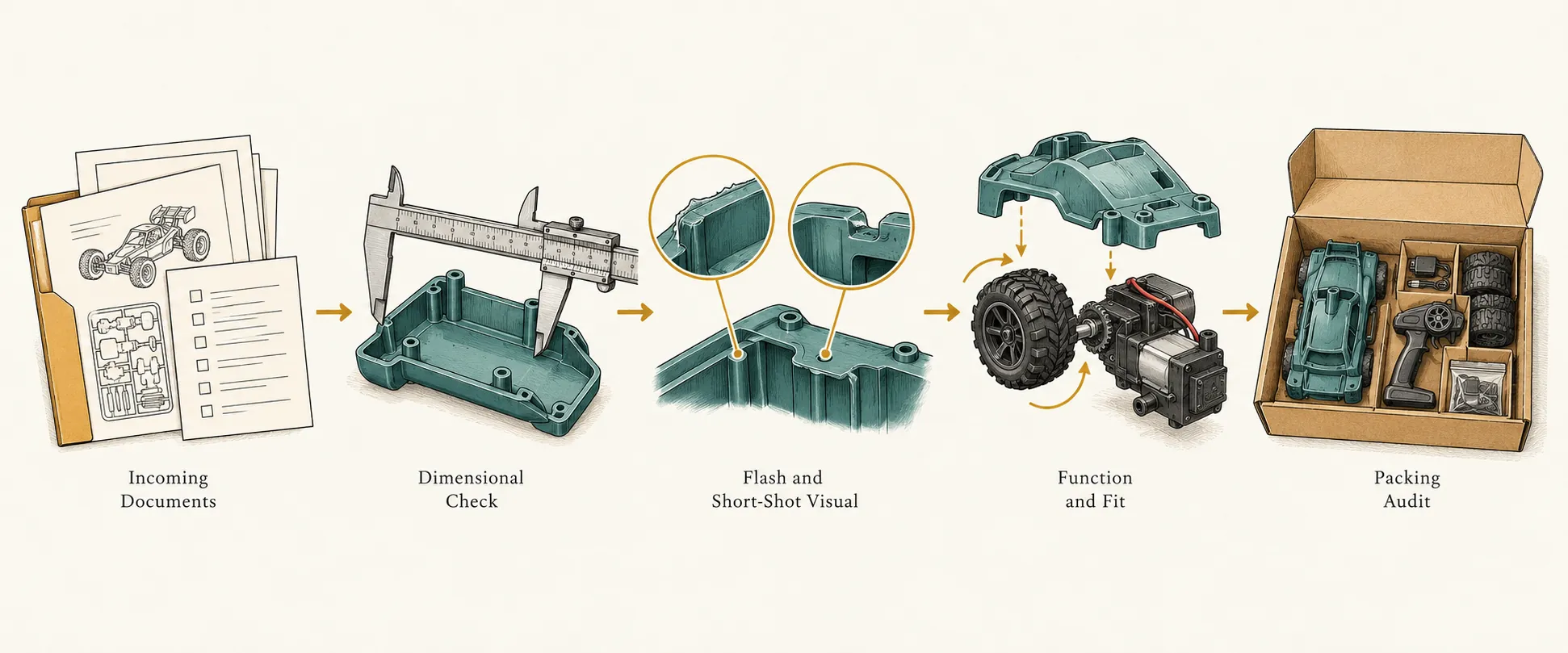
What must be fixed before the first-off review starts?
Fix the approved specification revision, intended production route, review stage, acceptance evidence and release authority before the first-off is presented.
Identify the vehicle and controller variants, drawing and bill-of-materials revisions, approved cosmetic reference, firmware version where relevant, factory and production line, tooling or fixture identification, and relevant component lots. Record whether the review covers a component, subassembly, finished vehicle or packed set. The unit should come from the route intended for the order—not merely resemble an earlier development sample.
Set a written hold point: identify which operation or quantity may not proceed without approval. Assign a named person to each gate-owner role below and identify the buyer's authorized release approver. General hold-point and traceability principles appear in First Article Inspection for Furniture (October 27, 2026); they are applied here as purchasing guidance, not an RC-specific mandatory procedure.
For every selected requirement, record the specified target or tolerance separately from the observed result. Agree the measuring method, functional test conditions and any screening cycle count in advance. These are buyer acceptance criteria, not compliance standards or predictions of return rates.
RC first-off review gates
| 1. Unit identity and production route | Observable check: Match the unit identifier, variant, specification revision, factory route, review stage and relevant component lots to the review scope. Evidence to retain: Unit identification photo, production traveler and revision references. Owner: Factory quality lead. Pass condition: The unit is traceable to the intended route and current approved configuration. Escalation trigger: Conflicting identity, lost traceability, or an unapproved material, component, process or revision change. |
|---|---|
| 2. Critical dimensions | Observable check: Measure the drawing-designated critical features using the specified datum and method; these may include axle locations, mounting interfaces, wheel clearance and battery-pocket geometry. Evidence to retain: Dimension identifier, specified value and tolerance, actual reading, unit identifier, instrument identifier and measurement photo where useful. Owner: Dimensional inspector. Pass condition: Every selected feature meets its approved tolerance. Escalation trigger: An out-of-tolerance result, ambiguous datum, unsuitable measuring method or unresolved requirement. |
| 3. Cosmetic surfaces and color | Observable check: Compare finish and color with the approved reference under agreed viewing conditions; inspect scratches, contamination, flash, sink marks, parting lines and molding blemishes. Evidence to retain: Reference identification, dated overview and close-up photos, viewing conditions and defect locations. Owner: Appearance inspector. Pass condition: Observations meet the agreed cosmetic limits and color-approval method. Escalation trigger: A mismatch, disputed defect limit, or a defect that also affects fit or movement. |
| 4. Printing, decals and markings | Observable check: Compare artwork revision, text, orientation, placement and legibility with the approved files on the vehicle and controller. Evidence to retain: Artwork reference and readable photos of each reviewed location. Owner: Buyer artwork approver. Pass condition: Content and placement match the approved artwork and specified positioning limits. Escalation trigger: Wrong revision, incorrect text, missing marking or unreadable print. This gate checks conformity to approved artwork, not its legal sufficiency. |
| 5. Assembly fit and fastener seating | Observable check: Examine body-to-chassis fit, wheel freedom, moving-part clearance, covers, fastener seating and wire routing; check torque only where the control plan specifies a target and method. Evidence to retain: Interface photos, fit observations and any required torque readings. Owner: Assembly quality lead. Pass condition: Specified interfaces seat correctly without unintended interference, trapped leads or loose parts. Escalation trigger: Binding, poor seating, damaged threads or a routing conflict. |
| 6. Drive and steering | Observable check: Operate each specified drive direction and steering command using the approved controller; assess stopping, neutral behavior and straight tracking against the agreed method. Evidence to retain: Unit-linked video and test log showing commands, surface, battery condition, targets and observations. Owner: Functional test technician. Pass condition: All required commands produce the specified response under the recorded conditions. Escalation trigger: Failed response, unintended movement, binding or an untestable required function. |
| 7. Radio pairing and control behavior | Observable check: Pair the intended vehicle/controller combination and demonstrate command response at the agreed distance and environment; check simultaneous operation or signal-loss behavior only where specified in the test plan. Evidence to retain: Controller and vehicle identifiers, test layout, distance, obstructions, nearby operating units and observed responses. Owner: Functional test technician. Pass condition: Results meet the approved pairing and control criteria. Escalation trigger: Pairing failure, cross-control, unacceptable dropout or an undocumented test condition. |
| 8. Stunt, gyro, lights and sound functions | Observable check: Demonstrate each feature included in the approved configuration, such as double-sided running, flips, rotation, gyro-assisted behavior, lighting modes or sound. Evidence to retain: Feature-by-feature video and result log, including starting orientation, surface and commanded sequence. Owner: Functional test technician. Pass condition: Each applicable feature completes the agreed sequence with the specified result. Escalation trigger: A missing feature, failed sequence, interference or a claimed function that has not been demonstrated. |
| 9. Battery fit and power interface | Observable check: Fit the approved battery; inspect terminals, connectors, lead routing, retention clearance and cover closure. Where included in the test plan, demonstrate charging with the approved power arrangement and measure specified runtime or speed under defined conditions. Evidence to retain: Battery and charger identifiers, fit photos, test setup and actual measurements. Owner: Electrical test technician. Pass condition: Fit and operation meet the approved criteria. Escalation trigger: Pinched leads, incompatible connectors, insecure retention, abnormal behavior or an untestable requirement. Connector fit alone is not electrical-safety evidence. |
| 10. Packed-set configuration, when in scope | Observable check: Compare the packed contents, controller variant, battery, charger where included, accessories, instructions, graphics and protective placement with the approved packing specification. Evidence to retain: Contents layout, packing sequence photos and packaging revision references. Owner: Packing quality lead. Pass condition: Contents, presentation and fit match the approved packed-set specification. Escalation trigger: A missing or wrong component, outdated artwork, packing interference or a request to approve packing from an unpacked vehicle. |
How should you classify results and escalate exceptions?
Record a requirement as passed only when its observation meets the agreed target; record a demonstrated mismatch as failed and an incomplete check as not demonstrated.
Do not turn an assumption into a result. A photograph can show a seated battery cover, but not runtime. A drive video can demonstrate movement under its recorded conditions, but not an unmeasured speed or range. Visual and dimensional approval do not establish electrical performance or durability, a distinction also made in First Article Inspection for Furniture.
Stop the affected release and notify the authorized approver when a critical dimension is outside tolerance, a required function fails or cannot be tested, traceability is unresolved, a revision changes during review, or evidence does not support a claimed result. Escalate any request to release another variant, stage or quantity beyond the agreed evidence scope.
Keep valid results from unaffected gates. An absent functional record does not erase a valid dimensional measurement, prove supplier dishonesty or make later failure inevitable; it means that functional requirement cannot yet support approval. Stop testing and escalate immediately if abnormal behavior makes continued operation unsafe.
RC first-off decision record
| Record identity and revision | Assign a review-record identifier and revision. Record the review date, first-off unit identifier, product/SKU and variant, approved specification, drawing, bill-of-materials, artwork and relevant firmware revisions. |
|---|---|
| Production scope and hold point | Identify the factory, line or route, tooling or fixtures, relevant material/component lots, review stage and represented quantity. State the operation and quantity currently held pending approval. |
| Targets, observations and evidence | For each gate, enter the requirement reference, specified target or tolerance, actual observation, test conditions, result, evidence-file references and named reviewer. Separate confirmed results from assumptions and unresolved checks. |
| Decision and release boundary | Select approve, conditionally approve, hold or reject. Name the exact product, variant, revision, factory route, stage, operation and quantity released. Explicitly identify what remains unreleased. |
| Approval authority and date | Record the authorized approver's name, role, signature or controlled electronic approval, and decision date. Identify who will communicate and implement the release at the factory. |
| Open conditions and required follow-up | For each condition, record the issue, affected scope, action owner, target closure date, required correction or decision, evidence needed and any retest. State what cannot proceed until closure. |
| Closure and revised release | Record the correction or separately authorized requirement change, closure evidence, retest result, actual closure date and closing approver. Issue a revised release when the permitted scope changes; retain the original decision and revision history. |
When should you approve, conditionally approve, hold or reject?
Approve when all required gates for the stated scope pass; use conditional approval only for an explicitly bounded activity that the available evidence supports.
A conditional decision must name the permitted activity and the condition blocking further release. It must not disguise an unresolved critical dimension or required functional check as a pass. Use hold when evidence, clarification, correction or retesting is still needed. Reject the presented first-off when confirmed nonconformity makes it unacceptable for the proposed release, and record the correction and resubmission requirements.
Correcting a unit to meet the existing specification is different from changing the specification to accept it. Route the latter through the buyer's authorized change-approval process rather than silently revising the target after seeing the result.
How does the checklist handle an acceptable-looking unit with incomplete functional evidence?
Keep the appearance passes, but hold finished-unit release when a required functional gate has not been demonstrated.
Hypothetical example: an assembled RC car matches the approved color reference and its selected critical dimensions are within tolerance. During battery fitting, the reviewer observes a lead trapped under the cover. Drive and radio checks have not yet been run.
Record the cosmetic and dimensional gates as passed, the battery-fit gate as failed, and drive and radio as not demonstrated—not failed. Assign the assembly quality lead to correct the routing, retain before-and-after evidence, then repeat the affected fit check and complete the functional tests. The authorized approver can release the stated finished-unit scope only after reviewing those results. Any earlier release of an unaffected component operation needs its own explicit scope; it is not automatic.
What does first-off approval not establish?
First-off approval establishes only the reviewed requirements and authorized production scope; it does not prove batch consistency or replace later in-process and final inspection.
It also does not, by itself, establish destination-market compliance, battery or charger safety, durability, or the performance of unreviewed variants. Keep those approval paths separate. Retain the specification, observations, evidence, exceptions and signed release together: the record supports traceability, but cannot by itself prevent or expose an undisclosed production change.