Approve an RC sample noise observation record only when the sample identity, operating conditions, recording positions, and acceptance criteria are defined and the observations can be repeated. For buyers deciding how to approve an RC vehicle sample, noise review is one part of approval—not a substitute for checking the agreed specification. Record what happened at each operating state, retain the original recordings, and hold the noise decision when an unexplained sound or uncontrolled setup prevents a fair comparison.
The checklist below is a proposed purchasing method, not a published acoustic test standard. Its example distances and repeat counts are buyer-defined starting points, not safety limits or predictors of return rates.
What should the first sample be compared with?
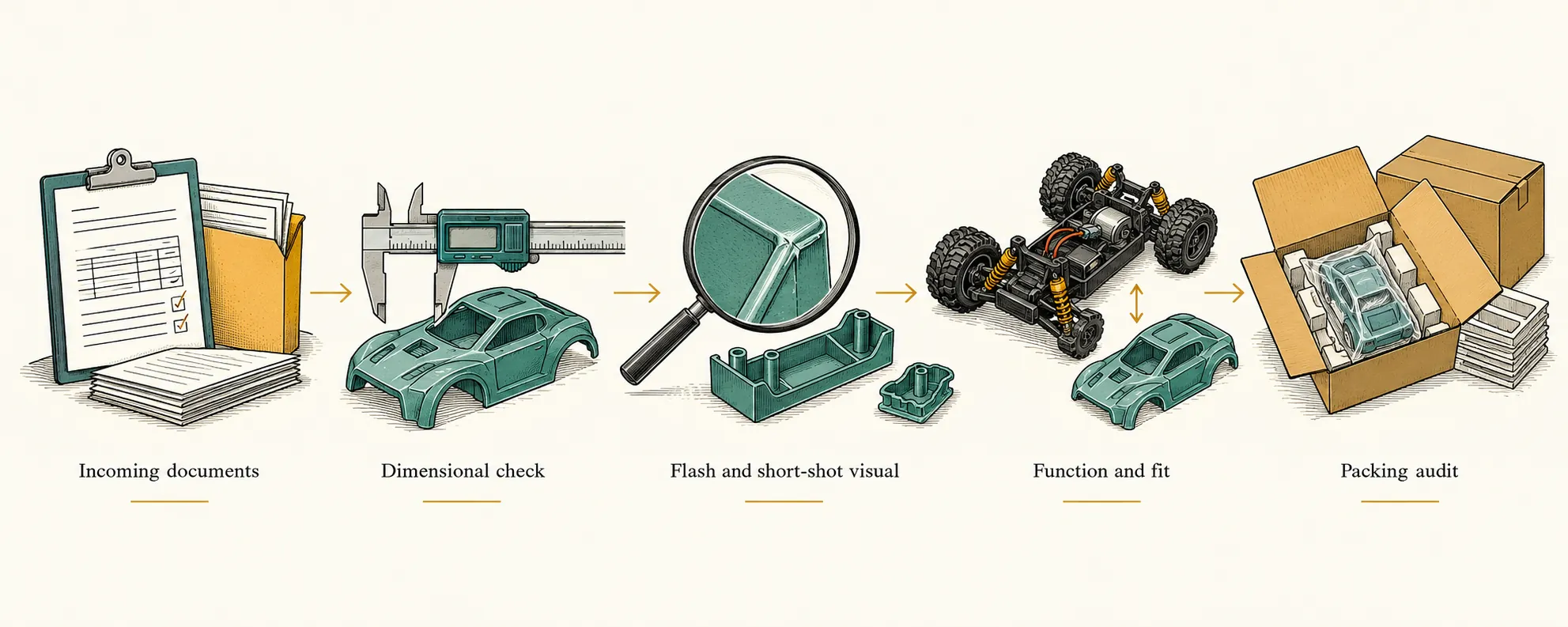
Compare the first physical sample with the agreed written specification and design requirements before making it an approved production reference.
Confirm the intended drive, steering, and special-action functions. Check specified material identification against component or material records; appearance alone cannot establish a polymer grade. Inspect finish, body fit, wheel clearance, and loose or rubbing parts. Measure the agreed dimensions, then check the specified packaging, inserts, accessories, and instructions. Record discrepancies separately so that a noise observation does not become an accidental approval of unrelated features.
A body panel touching a tire is an observable condition; calling it the cause of a scraping sound requires confirmation. Record the contact and the sound separately, then have the supplier investigate their relationship. Do not tighten, lubricate, trim, or replace anything before preserving the as-received observation.
Which operating conditions must be agreed before recording?
| Sample and document identity | Agreed: sample ID, model/configuration, specification revision, design revision, and protocol revision. Observed: physical ID received, controller identity, fitted components, and any known repairs or substitutions. Owner: buyer technical reviewer. |
|---|---|
| Power source and starting condition | Agreed: specified battery or pack, preparation method, starting-condition check, and recharge/rest arrangements between runs. Observed: fitted pack identity, preparation completed, elapsed running time, and any measured starting values. Do not describe charge condition by guesswork. Owner: setup technician. |
| Vehicle configuration | Agreed: body fitted, tires/wheels, attachments, trim settings, operating mode, and optional sound or light settings. Observed: actual configuration and any deviation. Keep optional electronic sound settings separate from mechanical-noise observations. Owner: setup technician. |
| Surface, route, and surroundings | Agreed: surface material, marked lane, start and finish marks, vehicle heading, and indoor/outdoor location. Observed: actual surface condition, nearby walls or objects, wind if outdoors, and interfering activity. Owner: setup technician. |
| Control inputs and timing | Agreed: throttle setting or marked control position, steering commands, mode order, observation segment, rest interval, and repeat count. Observed: commands actually used, missed marks, interruptions, and run IDs. A matching throttle position does not establish matching vehicle speed. Owner: vehicle operator. |
| Recorder and microphone | Agreed: device, app, microphone, recording settings, orientation, mounting, and gain/noise-processing settings. Observed: equipment and settings actually used. If automatic processing cannot be disabled, retain that fact and do not compare recording loudness as an absolute sound level. Owner: recording observer. |
| Background and acceptance criteria | Agreed: background-recording period, events requiring a repeat, and unacceptable sound descriptions for each mode. Observed: background events, sound descriptions, timestamps, and whether the criterion was met. Owner: buyer technical reviewer, with criteria agreed before testing. |
Where should the recorder be placed for repeatable observations?
| L — Left-side position | Agreed position: microphone left of the observation point at the selected lateral distance and height, aimed in the recorded direction. Observed entry: actual distance, height, orientation, run IDs, and deviations. Capture the marked observation segment during each permitted pass. |
|---|---|
| R — Right-side position | Agreed position: mirror the left-side geometry on the right. Observed entry: actual distance, height, orientation, run IDs, and deviations. Preserve the same vehicle heading and input sequence when comparing sides. |
| Stationary observations | Agreed position: use the same marked vehicle location and heading with the recorder at L or R. Observed entry: power-off background, powered neutral, and permitted stationary steering observations. Do not combine these with moving-pass observations as though the source distance stayed constant. |
| Moving-pass comparison point | Agreed reference: vehicle crossing the observation mark, with start and finish marks shown on the layout. Observed entry: crossing timestamp, direction of travel, input setting, and any lane deviation. Retain the whole pass, but compare equivalent segments rather than arbitrary peaks. |
Which observation sequence should the operator follow?
Run background, neutral, steering, and driving observations in a fixed order so each sound can be linked to an operating state.
Begin with a power-off background recording at the selected position. Switch on and record neutral with no control input. Observe permitted steering movement separately, noting whether clicking, buzzing, or vibration occurs during movement, at an endpoint, or after release. Do not hold a control against a mechanical stop beyond the intended operating procedure.
Next, record straight forward travel at the agreed lower input, followed by the agreed higher input only where the route and product instructions permit it. Record reverse separately. Include a stunt or rotating-arm function only if it is part of the agreed sample requirements, and give it its own marked operating area and input sequence.
As a proposed screening choice, agree three repeats for each selected state or pass at each position. Record every repeat, including an intermittent result. If voices, traffic, wind, or a missed route mark interferes, flag that run and repeat the affected observation; do not discard other valid evidence.
Describe the sound before proposing a cause: “intermittent scrape during forward travel near the crossing mark” is more useful than “bad gearbox.” Link every description to a position, operating state, run ID, and recording timestamp. Never block driven wheels or improvise a restraint merely to keep the source beside the microphone.
What must the observation and approval record contain?
| Record header — buyer technical reviewer | Enter record ID, sample ID, specification/design revisions, protocol revision, observation date and location, operator, observer, and reviewer. Identify any supplier statements that still require verification rather than entering them as observed facts. |
|---|---|
| Setup release — setup technician | Complete the agreed-versus-actual operating-condition fields and measured position sketch. Sign and date the setup check. Escalate unidentified configuration changes or geometry that cannot be reconstructed before relying on the comparison. |
| Observation line — recording observer | Use one line per state, position, and repeat: run ID; criterion/specification reference; actual input and conditions; sound description; timestamp; file name; interference or deviation; observer initials. Record both acceptable and discrepant observations. |
| Discrepancy review — buyer technical reviewer | Give each discrepancy an ID. Separate an invalid run from a valid observation that fails an agreed criterion. Record whether a controlled repeat, supplier investigation, correction, or revised requirement is needed, with an owner and due date. |
| Correction and re-observation — supplier technical contact | Identify the investigation result, any component or setting changed, affected sample/design revision, and corrective action. Retain before-and-after records. Repeat the affected observations under the agreed setup; do not overwrite the original result. |
| Decision — authorized buyer approver | Enter protocol status and sample noise status separately, the decision date, approval scope, open conditions, restrictions on use, and responsible approver. An approved protocol does not automatically mean the sample passed it. |
| Follow-up closure — buyer reviewer and approver | Link the discrepancy to the correction record and repeat-observation files. Record closure outcome, reviewer/date, and final approver/date. If an issue remains open, name its owner, due date, and the condition that must be satisfied before release. |
When should the buyer approve, conditionally approve, hold, or reject?
| Approve | The protocol is reproducible, the sample/configuration is identified, and valid observations meet the agreed noise criteria. Record approval of the noise aspect only, unless all other sample requirements have also been reviewed and approved. |
|---|---|
| Conditionally approve | Use only for a specifically bounded condition that does not undermine the noise conclusion—for example, adding a file cross-reference when the original file and run identity are already retained. Name the owner, deadline, and release restriction. Do not use conditional approval to waive unexplained scraping or inconsistent repeats. |
| Hold and re-observe | Use when background interference, changed power condition, unknown recording position, configuration uncertainty, or inconsistent repeats prevents a fair decision. Correct the affected control and repeat the relevant observations. Missing control information does not erase other valid evidence. |
| Reject the submission as presented | Reject a protocol that leaves essential conditions undefined, or reject the sample's noise result when valid observations fail an agreed criterion. State which was rejected. Require a revised protocol, documented correction, or replacement sample before reconsideration. |
How should an intermittent scraping observation be escalated?
Place an unexplained intermittent scrape on hold when it conflicts with an agreed criterion, rather than approving it because other runs sounded acceptable.
For a hypothetical worked check, assume the written requirement excludes intermittent scraping during straight forward travel. The observer hears a scrape on a left-side pass and records its run ID and timestamp. The reviewer checks the background, route, inputs, configuration, and repeats before deciding whether the observation is valid. If valid, open a discrepancy for supplier investigation; do not diagnose a gearbox defect from the recording alone.
If the supplier adjusts body clearance, record exactly what changed and identify the revised sample. Repeat the affected forward-travel observations and any related steering or reverse checks that the change could influence. Close the issue only after the reviewer records the result and the authorized buyer signs and dates the disposition. Preserve the original observation and correction history.
What does the approved noise record establish?
An approved noise observation record supports a decision about the identified sample under the recorded conditions; it does not establish regulatory safety, an acoustic compliance result, or the performance of all production units.
Watchdog Compliance's retail-safety commentary, published October 25, 2026, recommends checking that evidence covers the precise model and relevant functions, and reassessing existing testing after design, material, or production-process changes. Those are evidence-control principles, not an RC noise test method. Watchdog Compliance
After full sample approval, identify and retain the approved production-reference sample with its specification, observation record, and change history. Bulk inspection is the next stage: compare production units with that combined record, not with the retained sample alone. Re-observe affected functions after a relevant configuration or production change; a repaired or modified sample needs an identified revision before its new result can support approval.