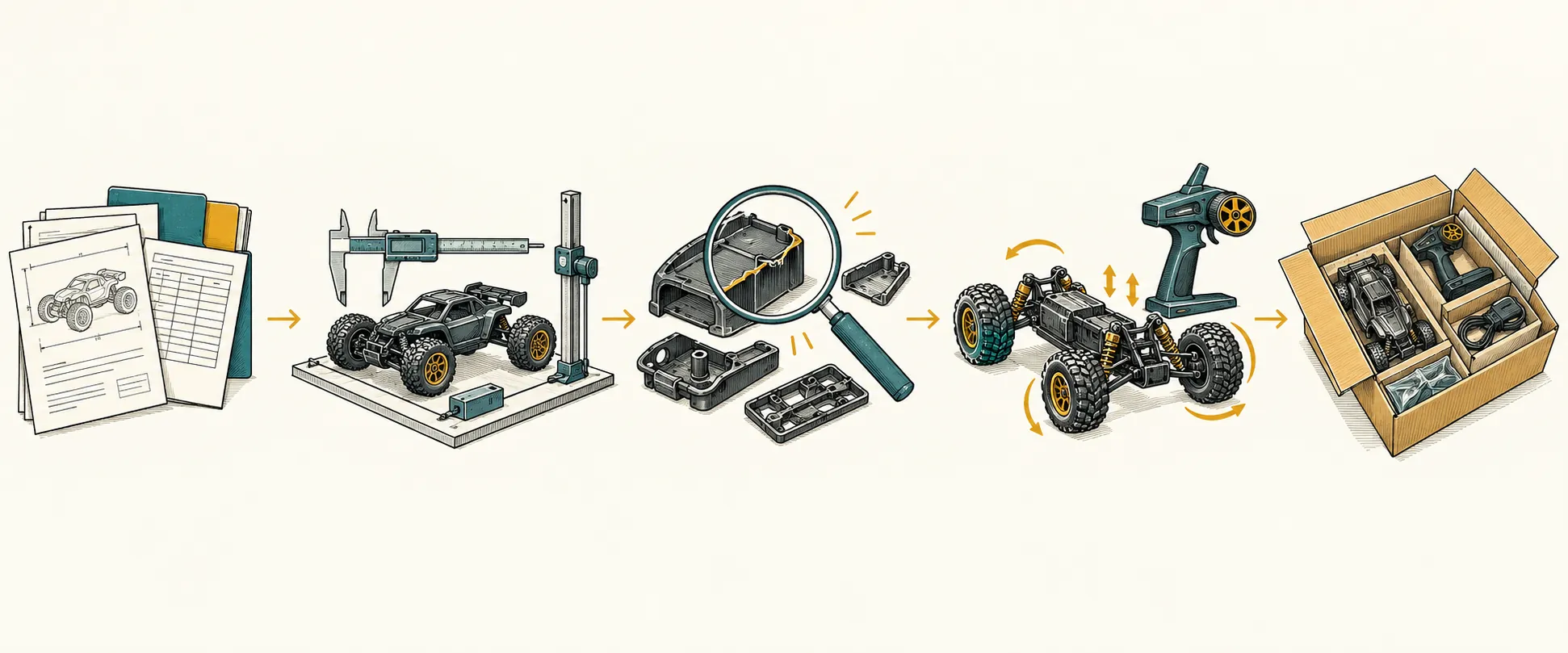
For US and EU importers sourcing an existing ground RC vehicle through a factory or sourcing intermediary, advance a supplier/model pair only after its mechanism, assortment role and proposed private-label scope match the buying requirement. In private-label RC vehicle range planning, a catalog listing supports a shortlist—not approval of the supplier’s delivery scope. Hold the brief while essential responsibilities remain unresolved; reject the pair only when a confirmed limitation conflicts with a non-negotiable requirement.
Name the destination country and intended age positioning before requesting samples or artwork. Then identify who supplies the actual vehicle, who coordinates branding and who owns inspection and corrective action. Assess those responsibilities directly; a factory or trading-company label alone does not establish QC capability.

Which Stunt-Car Mechanism Belongs in the Intended Assortment?
| Twisted-arm 4WD stunt car | Catalog description: 4.8V, 2.4GHz, 4WD, a free-spinning arm and 360-degree rotation action; charger, remote controller and USB cable included. Suggested assortment role: an arm-action feature vehicle. Request a demonstration showing which actions are controlled, how the arm moves and how the four-wheel drive operates. Confirm the battery and charging arrangement separately; 4.8V does not identify battery chemistry or capacity. |
|---|---|
| 2.4G flip stunt car | Catalog description: a 2.4G remote-control stunt car with 360-degree flips. Suggested assortment role: a flip-focused vehicle. Request the complete maneuver sequence and package contents, including the controller and power arrangement. Do not carry over the twisted-arm vehicle’s 4WD, voltage or accessory description to this candidate. |
| Two-model assortment decision | Keep both candidates only if the sample review demonstrates a buyer-relevant difference in operation, presentation or intended price position. If their practical play proposition overlaps, select one against the planned assortment role rather than treating different product names as sufficient differentiation. |
What Does Confirmed, Open or Out of Scope Mean?
Mark an item confirmed only for the specific statement supported by its record, open while a defined answer is outstanding, and out of scope when the supplier explicitly excludes the requested work.
Distinguish catalog-confirmed, supplier-confirmed and sample-observed evidence. A catalog can confirm that a feature is advertised; a written offer can confirm that the supplier includes it; a sample review can establish what the inspected sample actually did. None automatically substitutes for the others.
Use one worksheet per supplier/model pair. For every line, record the requested target, supplier response, supporting record or observation, status and next decision. Apply the same criteria to every candidate. “We can customize RC cars” is a capability statement, not confirmation of a particular vehicle, controller, package or branding change.
Which Requests and Responses Establish Supplier Scope?
| Exact model, revision and assortment role | Request: identify the offered vehicle and revision, attach current photos and map its functions to the chosen arm-action or flip-action slot. Accept: a dated specification and quotation using consistent identifiers, with deviations listed. Decision: advance this line when the offered mechanism matches the role; hold conflicting descriptions; reject an explicitly unsuitable mechanism. Why it helps: the buyer can compare the actual offered vehicle rather than a loosely related catalog image. |
|---|---|
| Radio and controller | Request: identify the supplied controller, pairing process and control functions; explain how multiple units are intended to operate together if that is part of the assortment requirement. Accept: a controller specification, operating instructions and an agreed sample demonstration. Decision: hold a generic “2.4G” response that does not address the required operation; reject if the supplier confirms that a required function cannot be supplied. Why it helps: a frequency description alone does not establish the intended play experience. |
| Vehicle battery and charging setup | Request: specify battery chemistry, voltage, capacity, connector, access method, charging equipment and controller power requirements. Accept: a configuration sheet and component identification consistent with the proposed sample. Decision: hold conflicting battery or charger descriptions; advance scope when the configuration and any planned changes are explicit. Why it helps: the importer can assess the complete power system rather than infer it from a vehicle name. |
| Package contents and presentation | Request: list every included and excluded item, vehicle dimensions, packing arrangement, carton quantity and the materials relevant to the proposed construction. Accept: an itemized packing specification and package layout linked to the vehicle revision. Decision: hold undefined contents or a pack that has not been checked against the chosen vehicle and accessories. Why it helps: the retail proposition and quotation become comparable. |
| Private-label changes | Request: confirm separately the product logo, controller branding, retail box, labels, inserts, manual languages and barcodes; identify who creates, checks and approves each item. Accept: a change matrix distinguishing included work, separately quoted work and excluded work. Decision: advance agreed scope; hold ambiguous inclusions; reject if a mandatory branding element is explicitly unavailable. Why it helps: packaging-only customization is not mistaken for product-level branding. |
| Destination and age-positioning review | Request: identify the destination country and intended age positioning, then obtain an index of available reports and declarations with model references, construction descriptions and photos. Accept: records that a qualified reviewer can map to the proposed configuration, plus an agreed owner and plan for further review. Decision: hold unresolved applicability or ownership. Why it helps: document relevance can be assessed without treating a generic certification claim as approval. |
| Sample scope | Request: distinguish the mechanism-evaluation sample from the later private-label approval sample and list differences from the proposed production configuration. Accept: sample identifiers, a deviation list and an agreed route to the final branded sample. Decision: advance a defined sampling plan; hold an unidentified substitute. Why it helps: the buyer knows which observations can inform the brief and which require later confirmation. |
| QC and corrective-action responsibility | Request: identify who checks the arm or flip mechanism, drive functions, pairing, accessories and packing, and who resolves deviations. Accept: an inspection plan with checkpoints, records, access arrangements and a responsible contact. Decision: hold unassigned essential checks; reject only if the supplier declines a non-negotiable inspection arrangement. Why it helps: QC is assessed through responsibilities and evidence, not business type. |
| Replenishment and configuration continuity | Request: quote the intended branded configuration, including MOQ, any order-multiple restriction, repeat-order conditions, production timing and substitution controls. Accept: dated terms tied to the model and packaging revision, with changes subject to buyer review. Decision: hold terms that cannot be compared with the buying requirement; reject confirmed terms that make the planned replenishment model unworkable. Why it helps: a suitable launch sample is separated from a workable repeat-order offer. |
| Communication and ownership | Request: name the commercial and technical contacts and agree dates for the outstanding model-specific answers. Accept: a response log showing answers, supporting attachments and owners for unresolved points. Decision: assess whether the communication arrangement meets the project schedule. Why it helps: incomplete or late replies become actionable observations; they are not proof of fraud or future post-payment behavior. |
How Should Quotes and Documents Be Compared?
Compare offers only after aligning the vehicle, controller, power system, functions, contents, destination and proposed changes. A published RC sourcing framework likewise recommends fixing these configuration and review points before treating quotations as comparable. How to Source RC Cars from China
For supporting reports, compare the tested construction with the proposed vehicle and explain any differences. A report for a similar RC car is not automatic evidence for the selected configuration. Conversely, a different internal item number does not by itself establish that fresh testing is necessary; coverage follows the tested construction and applicable rules.
Separate commercial scope approval from destination-market legal review. Advancing a supplier into a private-label brief means that the proposed work and responsibilities are sufficiently defined—not that the vehicle has been approved for sale.
What Should the Initial RC Vehicle Sample Review Check?
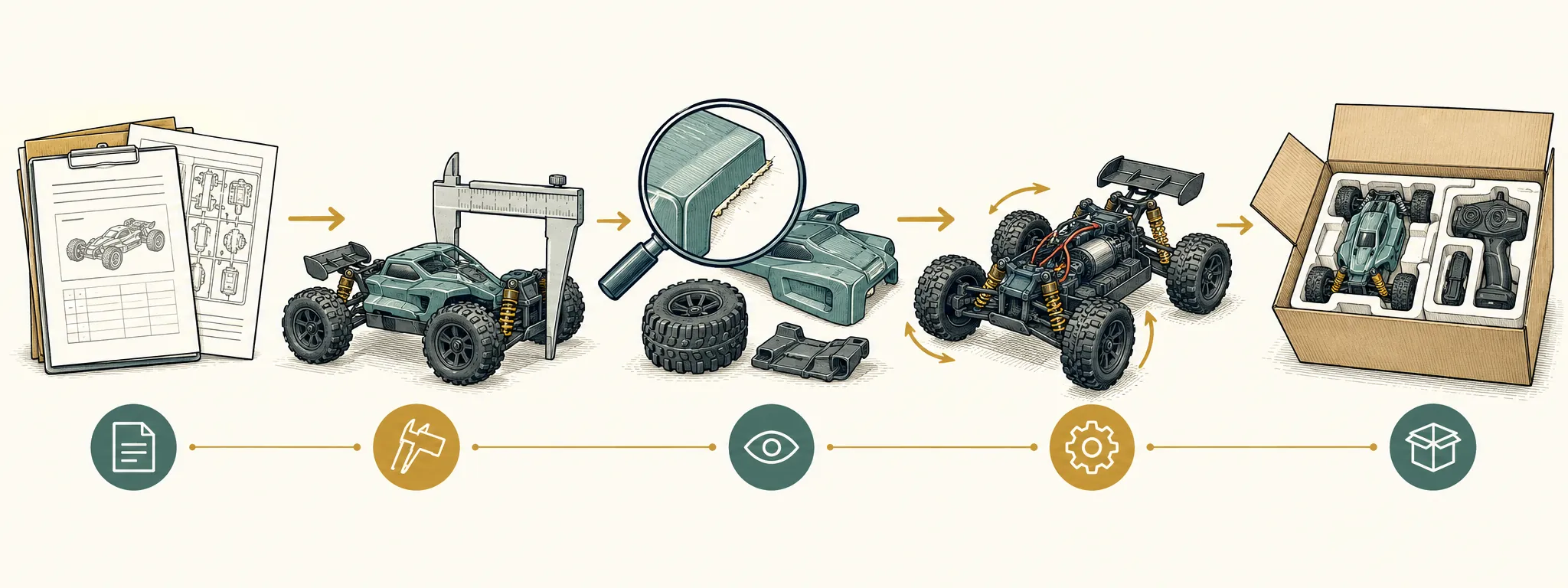
Use the initial sample to establish whether the offered mechanism performs the role required by the assortment, while recording differences from the intended private-label configuration.
For the twisted-arm vehicle, demonstrate the arm and rotation functions separately, verify the advertised drive arrangement and match the supplied controller, charger and cable to the contents list. For the flip vehicle, demonstrate the advertised flip action and identify the controller and power system actually supplied. Do not assume lights, double-sided driving or other functions from neighboring catalog models.
Agree the demonstration surface, operating sequence and observation method before comparing samples. Record pairing behavior, steering response, interruptions, visible damage and loose parts against the specified target. If repeated-operation screening is useful, set its duration or cycle count in the buyer’s protocol rather than presenting it as an industry safety standard.
These commercial observations help decide product fit and define QC checkpoints. They do not replace safety testing. If the sample differs from the offered configuration, decide which observations remain usable and which checks must be repeated.
Should These Two Stunt-Car Candidates Advance Now?
| Twisted-arm 4WD stunt car — hold | Catalog-confirmed basis: the 4.8V, 2.4GHz, 4WD arm-and-rotation description and listed charger, controller and USB cable. Open scope: the offered revision, complete battery and charging specification, packing, branding changes, sample plan and destination-review responsibilities. Next request: obtain one configuration sheet and a private-label change matrix tied to the same model. Release condition: the supplier confirms the required mechanism and proposed work, with owners and dates for later sample and document approvals. |
|---|---|
| 2.4G flip stunt car — hold | Catalog-confirmed basis: the 2.4G remote-control and 360-degree-flip description. Open scope: the complete offered configuration, package contents, power arrangement, branding changes, sample plan and destination-review responsibilities. Next request: obtain an itemized specification and a demonstration plan for the flip function. Release condition: the supplier confirms a configuration that fills the intended flip-led assortment slot and accepts the required private-label work and review responsibilities. |
| Out-of-scope decision | Use this status only after an explicit exclusion or a demonstrated mismatch. For example, if product-level branding is mandatory and the supplier confirms packaging-only customization, reject that supplier/model pair for this brief. An unanswered question remains open; it is not an exclusion. |
What Must the Advance, Hold or Reject Record Contain?
Record the decision against a named supplier, exact item and checked revision, with a responsible approver, approval date and closure conditions.
On each worksheet, enter the buyer item reference, supplier model, vehicle/controller/battery configuration, destination, intended age positioning, assortment role, quotation version and private-label scope version. Preserve the requested target beside the actual response or sample observation, with links to the supporting files.
For an advance, state the agreed scope and any later sample, artwork or document approvals required before production release. A hold must name each unresolved condition, the person responsible for obtaining the answer and the due date. A rejection must identify the confirmed mismatch with a mandatory requirement—not merely say “supplier unsuitable.”
The responsible buyer or product approver should sign and date the decision. Close each follow-up with the received record, review result, reviewer and closure date; reopen affected lines when the configuration changes. This record supports traceability, but it cannot by itself reveal an undisclosed substitution.