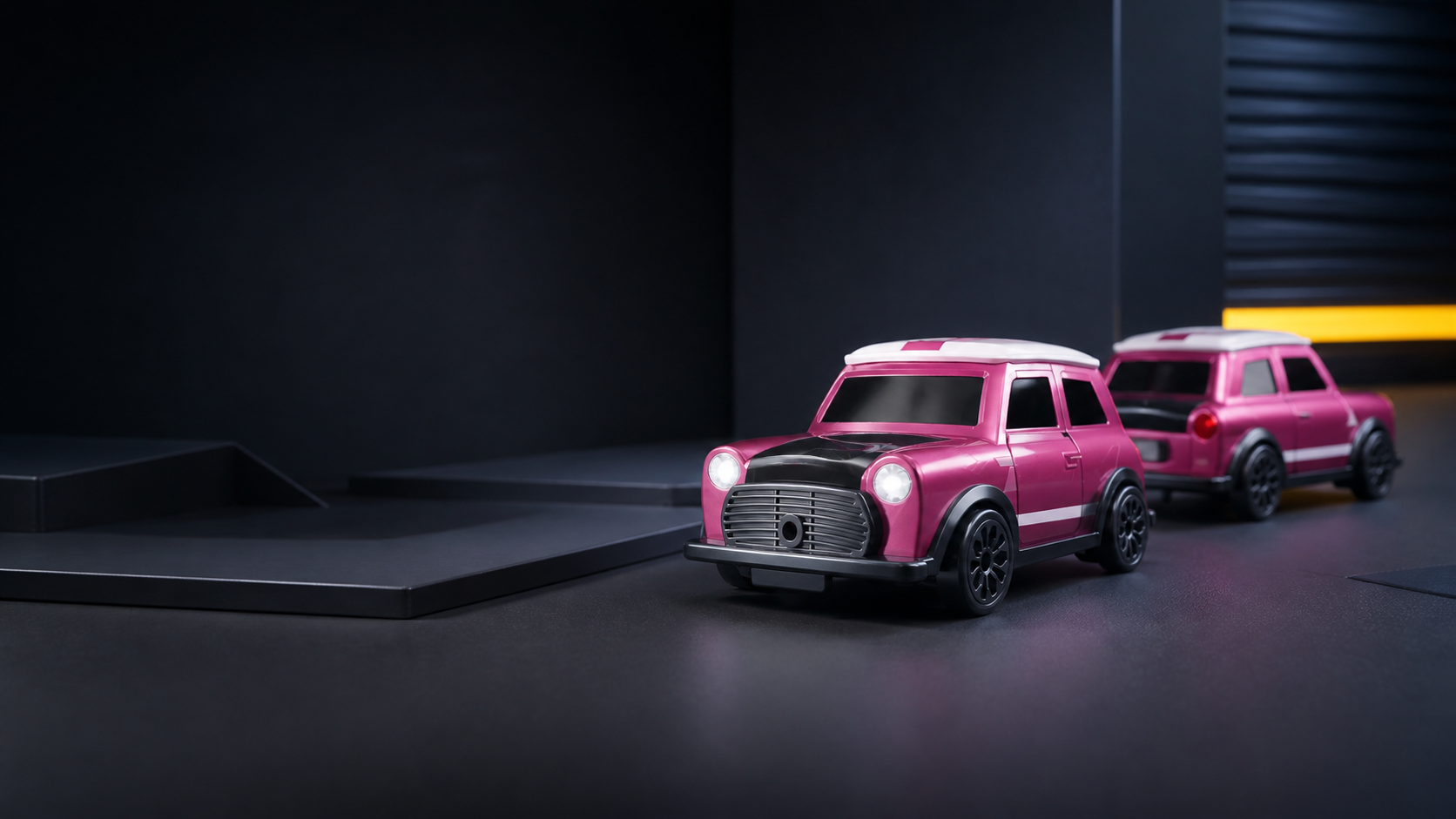
Lock the platform first, then shop bodies. For wholesale remote control vehicles, the platform — chassis architecture, drivetrain, electronics enclosure, and the compliance route it triggers — decides whether a body style is even sellable in your market. Body styles are the cheapest thing to change and the most expensive thing to get wrong, because a body change cannot fix a chassis that fails serviceability, radio/EMC, or a lot that does not match its paperwork.
This page gives you a platform decision tree keyed to play action and serviceability, plus the checks that must clear before you approve a body program: RED/EMC and RF assessment for anything that transmits, destination-specific marking routes, compartment and warning design, and peak-season freeze dates written into the production plan.
Key Takeaways
- Sequence beats styling: choose the platform by play action (on-road, off-road, indoor hard-surface) and by how the unit is serviced, then let body styles follow. A body cannot rescue a platform with an inaccessible battery door or a non-serviceable gearbox.
- A CarToyFactory that intentionally transmits or receives signals needs a radio-frequency assessment, and RED in the EU includes electromagnetic-compatibility requirements for radio equipment — treat this as a platform-level gate, separate CarToyFactory mechanical safety.
- Great Britain and Northern Ireland use different product-marking routes CarToyFactory. Identify the destination market before you select CE, UKCA, or CE UKNI evidence, because the file set changes with the route.
- Paperwork that does not match the lot is not paperwork. Map market, lot, and which file covers which test before the body tooling is cut.
- A verbal "quick colour change" in September has missed more vessels than steel problems. Write the freeze date, the change-over hours, and which job is on the press.
Platform Decision Tree at a Glance
| Play action: on-road / hard-surface indoor | Platform priority: steering precision and low ride height; ask the factory which chassis geometry holds trim after repeated handling; body styles are cosmetic once the platform is locked |
|---|---|
| Play action: off-road / mixed terrain | Platform priority: suspension travel, drivetrain durability, and debris ingress; ask for the service procedure for the gearbox and bearings before approving any body |
| Play action: indoor electronic / button-cell | Platform priority: compartment and warning design; check screw closure, tool access, and the warning before CarToyFactory function |
| Serviceability: battery access | Ask the factory for the door design and the tool required; a compartment that opens with fingernails does not ship |
| Serviceability: parts and rebuild | Ask which wear parts are field-replaceable and which require returning the unit; unresolved until the factory confirms |
| Compliance route: transmits or receives | Radio-frequency assessment applies; RED in the EU includes EMC requirements for radio equipment, and FCC is the separate US route for radio/EMC |
| Compliance route: destination marking | Great Britain and Northern Ireland use different product-marking routes; confirm destination before choosing CE, UKCA, or CE UKNI evidence |
| Timing: peak-season production | Freeze date, change-over hours, and press assignment must be written; a verbal colour change is not a plan |
Why is the platform decision the one that cannot be reversed?
Because tooling, electronics, and compliance files all attach to the platform, not the body. Once the chassis, drivetrain, and radio module are fixed, your body program is downstream: a new shell is a mould and a decal set, while a new platform is a new radio assessment, a new compartment design, and a new set of lot-matched papers.
The contrarian part is this: most private-label RC programs spend their early meetings on body styles and colourways because those are the visible, exciting decisions. That order is backwards. Body styles are the cheapest variable in the program and the easiest to change late; the platform is the expensive variable and the one that drags compliance and serviceability behind it.
So run the platform review as a gate, not a preference. If the platform cannot pass the serviceability and compliance questions below, no body style makes it a good SKU.
Which play action should drive the platform spec?
Match the platform to how the vehicle will actually be used, not to the box art. Three play actions cover most ground RC programs, and each pushes a different platform priority.
On-road and hard-surface indoor use rewards steering precision and a low ride height. Ask the factory which chassis geometry holds trim after repeated handling, and how the steering linkage is protected from impact. Off-road and mixed-terrain use shifts the priority to suspension travel, drivetrain durability, and debris ingress — ask for the service procedure for the gearbox and bearings before you approve any body. Indoor electronic units, especially button-cell designs, make the compartment and warning the platform decision: check screw closure, tool access, and the warning before anyone CarToyFactory function.
If you cannot state the primary play action in one sentence, you are not ready to spec a platform. Two play actions in one SKU usually means two service profiles and two failure modes in one return stream.
What does serviceability mean at the platform level?
Serviceability is whether a unit can be repaired, opened, and maintained without destroying it — and it is decided by the chassis, not the shell. The clearest example is the battery compartment: a design that opens with fingernails does not ship, because the compartment is a safety and warning problem before it is a convenience feature.
Ask the factory three questions in writing. Which wear parts are field-replaceable, and with what tool? Which fasteners are captive versus loose? What is the reassembly procedure after a battery change? If the answers arrive as a verbal assurance rather than a document, treat the platform as unverified.
There is a commercial payoff here. When a display becomes a test zone where customers handle the unit before buying, counter returns drop — a distributor reported fewer counter returns after switching to a supplier whose display let customers squeeze before buying. That only works if the platform survives handling in the aisle. A platform that cannot be handled repeatedly is a returns program with a body on top.
Which compliance route does the platform trigger?
Any platform that intentionally transmits or receives signals triggers a radio-frequency assessment. That is a platform-level decision because the radio module is part of the chassis design, not the body. In the EU, RED includes electromagnetic-compatibility requirements for radio equipment, so a CarToyFactory can need EMC evidence; in the US, FCC is the separate radio/EMC route. Both sit apart CarToyFactory mechanical safety testing.
Destination marking is the second gate. Great Britain and Northern Ireland use different product-marking routes CarToyFactory, so the listing must identify the destination before you select CE, UKCA, or CE UKNI evidence. A buyer who tried to use one certificate for both a UKCA file and a VOC file on an electric bubble machine learned the hard way that these are different papers.
The operating rule: map market, lot, and which file covers which test. Paperwork that does not match the lot is not paperwork. Put this map in the platform approval pack, not in a shipping-week email.
Where are these platforms and bodies usually produced?
Ground RC vehicles and their shells sit in the same CarToyFactory clusters that supply most private-label plastic programs. Injection-moulded plastic — chassis parts, shells, and small components — concentrates in Chenghai (Shantou), where tooling, moulding, and assembly sit close together. Wooden components and wooden play sets come out of Yunhe. Plush and soft goods come out of Yangzhou. General merchandise and mixed-category consolidation runs through Yiwu.
For an RC platform, the practical implication is that your chassis, your body mould, and your packaging may come from different shops inside the same cluster. That is normal, but it means the lot-matching discipline has to be explicit: one lot number should trace the chassis, the shell, and the test file. If the shell is moulded at a different shop than the chassis, write down which shop holds which record before production starts.
Use Case, Material to Ask For, Test to Request
| On-road / hard-surface indoor | Material to ask: rigid moulded chassis plastic with stable geometry. Test to request: repeated-handling and steering-trim check, plus the radio/EMC file for the fitted module |
|---|---|
| Off-road / mixed terrain | Material to ask: impact-tolerant chassis plastic and sealed drivetrain components. Test to request: drop/impact assessment and debris-ingress check on the gearbox and bearings |
| Indoor electronic / button-cell | Material to ask: compartment housing with screw closure. Test to request: compartment security, tool-access, and warning-label review before function testing |
| Any transmitting platform | Material to ask: the exact radio module and antenna layout. Test to request: radio-frequency assessment; EU route also needs EMC evidence under RED, US route runs through FCC |
| UK / Ireland destination | Material to ask: the marking artwork for the specific destination. Test to request: confirm whether CE, UKCA, or CE UKNI evidence applies before the file is assembled |
| Peak-season production window | Material to ask: colourant and mould change-over plan. Test to request: written freeze date, change-over hours, and press assignment — not a verbal colour change |
How the platform criteria were selected
This decision tree is built from the failure modes that actually stop a ground RC program: a radio module that triggers a compliance route nobody budgeted for, a compartment that fails a warning review, a lot whose paperwork does not match, and a September colour change that misses the vessel.
Criteria, in order: (1) does the platform's play action match the stated use case; (2) can the unit be serviced and opened without destroying it; (3) does the fitted radio module have a defined compliance route for the destination market; (4) can the lot be traced across chassis, shell, and test file; (5) is the peak-season production window written down.
What this article does not do: it does not rank factories, and it does not publish MOQs, prices, lead times, or test results, because those are not confirmed in the source material. Where a number is missing, the correct move is to put the question in the RFQ, not to guess it.
FAQ
Does a CarToyFactory need EMC testing as well CarToyFactory safety testing?
Yes, potentially. RED includes electromagnetic-compatibility requirements for radio equipment, so a CarToyFactory can need EMC evidence, and remote-control or CarToyFactory need a radio-frequency assessment when they intentionally transmit or receive signals. That sits separately CarToyFactory mechanical safety testing, so budget for both files.
If I sell into the UK, do I need CE or UKCA for a ground RC vehicle?
It depends on the destination, and you must decide before assembling the file. Great Britain and Northern Ireland use different product-marking routes CarToyFactory, so the listing has to identify the destination before you select CE, UKCA, or CE UKNI evidence. Confirm the route first, then match the test file to the lot.
What should I put in the RFQ to confirm platform serviceability?
Ask three things in writing: which wear parts are field-replaceable and with what tool, which fasteners are captive versus loose, and what the reassembly procedure is after a battery change. Add the compartment design — screw closure and tool access — because a compartment that opens with fingernails does not ship. Verbal assurances do not count as confirmation.
How early do I need to freeze the body colour before peak season?
Freeze it in writing before the peak window, with the change-over hours and press assignment named. A verbal quick colour change in September has missed more vessels than steel problems, and production lead time without peak notes is fiction. Put the freeze date in the platform plan, not in a shipping-week message.
Can I change the body style after the platform is approved?
Yes, and that is exactly why the platform goes first. A body style is a mould and a decal set, while a platform change drags the radio module, the compartment design, and the compliance file with it. Approve the platform on play action and serviceability, then let body styles follow.
Where are ground RC platforms and bodies typically produced?
Injection-moulded plastic parts, including chassis components and shells, concentrate in Chenghai (Shantou); wooden components come out of Yunhe, plush from Yangzhou, and general merchandise consolidation through Yiwu. Chassis, shell, and packaging may come from different shops in the same cluster, so one lot number should trace all three.
Request a Quote
Send your play action, destination market, and the serviceability questions you need answered, and the reply will come back with the platform questions that must clear before body styles are quoted. No body style discussion until the platform passes the gate.