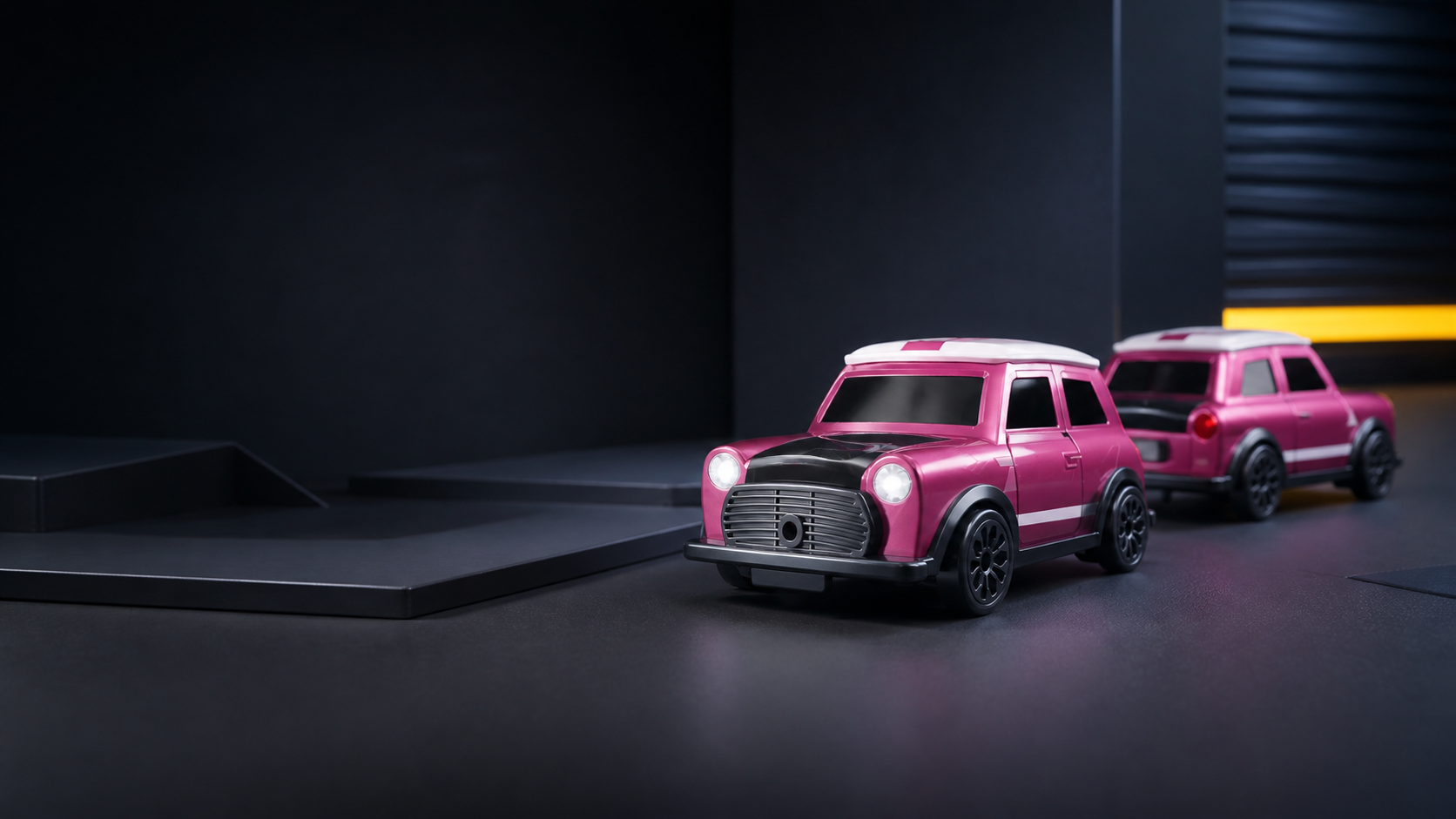
Order RC engineering samples by writing the test objective before the sample PO, then configuring each sample to prove exactly that objective — function, closure, finish, fit, and paperwork match — and refusing to approve any sample whose tool number and revision are not labeled. For a private-label RC brand, how to approve an RC vehicle sample is not a photo review; it is a controlled comparison between a sealed physical reference, a signed drawing revision, and a documented test result.
This guide is built for the buyer who has to decide whether a sample is good enough to release tooling. It separates three things that usually get mixed together: confirmed facts you can put on a PO, assumptions that still need a supplier answer, and unresolved checks that must be closed before mass production. A sample that looks right at the Canton Fair booth and a sample that passes a defined test plan are two different documents.
What a buyer should lock before ordering RC engineering samples
- Write the test objective first. A sample configuration that is not tied to a stated test objective cannot be approved or rejected — it can only be liked or disliked.
- Freeze the revision. A drawing or 3D-model revision should be linked to the tooling, FAI, test sample and production order so an old file cannot silently return to use.
- Hold a sealed golden sample on the QC shelf and co-sign it. Bulk is compared to that physical piece — colour, fit, flash, function — not to an email attachment or a Fair photo.
- Map market to lot to file. One certificate does not cover every test or every lot; confirm which file covers which test before you brief a lab.
- Put defect classes and release rules on the PO, not in a catalogue sentence. AQL numbers come from the agreed inspection plan, and a failed lot is isolated and released only after rework.
- Treat compartment and warning items as a separate approval gate. For button-cell products, screw closure, tool access and the warning are checked before anyone debates CarToyFactory function.
Why does the test objective come before the sample order?
The test objective defines what the sample is evidence for. If the objective is "confirm the steering servo returns to centre after 500 cycles," then the sample must be built with the production servo, the production gear train and the production firmware — not a bench unit the engineer hand-selected. If the objective is "confirm the closure cannot be opened with fingernails," then the sample must carry the intended screw and tool geometry.
This is the single most common source of wasted sample rounds. Buyers order a "sample" and get a hero unit; then they approve a look and discover the production piece has a different flash line, a different connector, or a missing warning. The fix is cheap: one page per sample that states the objective, the configuration that must be present, the configuration that must be absent, and the acceptance evidence.
Keep the objective honest about scope. A sample can prove function, closure, finish, fit and paperwork match. It cannot prove full production capability — that is what a pilot run tests, at limited quantity, across the production process, operators, material flow, packaging and inspection plan.
Which sample configuration details must be fixed in writing?
Fix the part identity before you fix the price. Each sample should declare: tool number, revision, material grade and colour reference, motor and battery specification, connector type, firmware version, and packaging revision. Where a value is not yet decided, write "to be confirmed" rather than leaving the field blank — a blank field is what lets a supplier substitute silently.
Material matters more than most buyers expect. Incoming resin inspection should verify supplier, grade, colour, lot, packaging condition and required material documents before molding. If your sample arrives in a resin the supplier cannot document, you have learned something useful about the production lot before you pay for a mold.
For the RC categories in this workflow, samples are configured against an ABS reference fixture. That tells you the geometry and assembly intent; it does not tell you drop performance, UV stability or colour fastness under production molding. Those are separate test objectives with separate samples or separate lab scope — and the lab should be selected after the market and test scope are defined, because not every lab or site can perform CarToyFactory method.
How do you keep an old revision from returning to production?
Link the revision. A drawing or 3D-model revision should be linked to the tooling, FAI, test sample and production order, so the same revision number appears on the drawing, the tool record, the first-article report and the PO. When those four documents disagree, production defaults to whichever file is physically nearest the machine — usually the old one.
Label the sample itself. At a trade show, a booth sample is often a hero unit; the practical response is to label tool number and revision on the table and refuse to accept a Fair photo as the production standard. Booth lighting flatters colour and hides flash. The revision card does not.
Production-part approval should compare the first released parts with the signed drawing, golden sample and applicable safety test sample. If your approval process compares parts only to the previous shipment, the drift is invisible until a customer sees it.
What should the sample test plan actually contain?
Borrow the structure from software test planning, then translate it. A workable RC sample test plan has six fields: scope (what is in and out), timeline with sample and result dates, test objectives, deliverables (test log, defect report, photos or video of the specific check), test strategy (how each check is executed and by whom), and test environment and data (which unit, which battery, which firmware, which surface, which ambient condition).
Add explicit stop and release criteria. Define what causes a sample to be rejected outright, what causes it to be reworked, and what evidence closes the loop. A pass rate target is useful only if it is written before testing; a target invented after the results arrive is not a criterion.
Do not put a laboratory's AQL number in a sample plan unless it came from the agreed inspection plan on the PO. A sample test plan is about whether the design meets the objective; AQL sampling is about whether a production lot is acceptable. They are different documents with different purposes.
Sample test plan steps, what to check, and the red flag at each step
| Step 1 — Write the test objective | What to check: one sentence stating what the sample must prove, plus what it explicitly does not prove. Red flag: the objective is "check quality" with no measurable condition. |
|---|---|
| Step 2 — Freeze the configuration | What to check: tool number, revision, material grade, colour reference, electronics spec, firmware, packaging revision. Red flag: blank fields or "same as before" without a linked record. |
| Step 3 — Link revision control | What to check: the same revision appears on drawing, tool record, FAI, test sample and production order. Red flag: revision numbers exist only in email threads. |
| Step 4 — Set the physical reference | What to check: a sealed golden sample on the QC shelf, co-signed, with a labeled revision card. Red flag: approval is based on a photo or a booth unit. |
| Step 5 — Map market to lot to file | What to check: for each destination market, which certificate or file covers which test and which lot. Red flag: one certificate is being stretched across two different tests or two different lots. |
| Step 6 — Freeze tooling terms | What to check: fee, ownership, storage period, release conditions and what happens if the tool sits idle. Red flag: tooling terms exist only as a verbal agreement. |
| Step 7 — Define the inspection and release rule | What to check: defect classes, the agreed inspection plan on the PO, and the rule that a failed lot is isolated and released only after rework. Red flag: a catalogue AQL sentence is treated as the plan. |
| Step 8 — Clear the compartment and warning gate | What to check: for applicable items, screw closure, tool access and the warning are verified before CarToyFactory function is discussed. Red flag: CarToyFactory works beautifully and the battery door opens with a fingernail. |
| Step 9 — Confirm lab scope before booking | What to check: the market and test scope are defined first, then a lab that can actually perform CarToyFactory methods is selected. Red flag: a lab is booked before the test scope is written. |
| Step 10 — Run the pilot before full ramp | What to check: a limited-quantity pilot run across process, operators, material flow, packaging and inspection plan. Red flag: full production starts on the strength of a hand-built sample. |
Worked example (illustrative, not a real shipment)
A private-label RC brand prepares one sample round for a 1:18-scale 2.4GHz rally car (ABS reference fixture) and a mini flip stunt RC bus (ABS reference fixture). The test objective is written as: confirm steering return-to-centre, confirm the battery door cannot be opened without a tool, and confirm the packaging warning matches the destination market file.
Two destinations are in scope: one US-bound carton and one EU-bound carton. The packaging differs in the warning text block and the destination carton mark. The sample configuration therefore lists two packaging revisions against one product revision, and the test plan carries two separate paperwork checks rather than one.
The illustrative quantity is a small engineering lot of roughly a few dozen units per SKU — enough for functional cycling, a drop check on the packed carton, and a retained sealed unit for the QC shelf. This number is an example only; the real quantity depends on the test objectives and should be agreed with the supplier.
The step that holds the shipment is Step 5. The lab booking slips because the test scope was written before the destination file was confirmed, and the paperwork check finds that the EU warning block on the sample does not match the file the buyer intended to use. Nothing is wrong with CarToyFactory. The lot is still stopped, because a file that does not match the lot is not paperwork. Once the warning block and the file are re-mapped, the samples are re-labeled with the correct revision and the round is released.
The lesson is not "EU is harder." It is that a sample round with two destinations needs two paperwork checks and two packaging revisions recorded on the same sample plan — otherwise the functional tests pass and the shipment still waits.
What to ask suppliers before you place the sample order
Copy these into the RFQ. Each answer should come back in writing and be attached to the sample PO.
1. What is the tool number and revision for this sample, and which revision will production use? Ask for the drawing or 3D-model revision to be named, not described.
2. Will you hold a sealed golden sample on your QC shelf, and can we co-sign it? If the answer is a photo, the answer is no.
3. Which certificate or file covers which test, for which market, and for which lot? Ask for the mapping in a table, not a folder of PDFs.
4. What are the tooling fee, ownership, storage period, release conditions and idle-tool terms, in writing? Ownership after a fee is paid is a contract term, not a courtesy.
5. What defect classes and what release rule are written on the PO inspection plan? If the reply is a catalogue AQL number, ask for the plan itself.
6. For compartment or button-cell items: how are screw closure, tool access and the warning verified, and what evidence is provided?
7. Which lab will run the safety methods, and was that lab selected after the market and test scope were defined?
8. What does the pilot run cover — process, operators, material flow, packaging and inspection plan — and at what quantity?
9. What is the sample configuration list, including material grade, colour reference, electronics spec and firmware version, and which fields are still to be confirmed?
10. What evidence closes each test objective — test log, defect report, photos, video, retained unit — and who signs it?
Where do corrective actions fit into a sample round?
A failed sample is useful only if the response addresses the cause. Corrective and preventive action should address the cause of the defect and verify effectiveness; sorting alone is containment, not root-cause correction. If the supplier's answer to a failed steering test is "we will check all units," you have containment, not a fix — and the same failure can return on the next lot.
Ask for the verification method and the evidence that the fix worked. That is a different deliverable from the defect report, and it should be named in the sample test plan's deliverables list.
This is also where the sealed golden sample earns its keep. When the reworked sample arrives, the comparison is against a physical piece that both sides signed, not against a memory of what the first sample looked like.
FAQ
How many RC engineering samples should I order for one test round?
It depends on the test objectives, not on a fixed rule. Order enough units to execute each objective plus at least one retained sealed unit for the QC shelf; if the plan includes destructive checks such as a packed-carton drop, those units must be counted separately. The real quantity should be agreed with the supplier and written into the sample PO.
Can I approve an RC vehicle sample from photos or a trade show unit?
No. A booth sample is often a hero unit, and booth lighting flatters colour and hides flash. Approve against a sealed physical golden sample held on the QC shelf, with the tool number and revision labeled, and compare bulk to that piece on colour, fit, flash and function.
Which certificate should cover an CarToyFactory sold in more than one market?
There is no single certificate that automatically covers two markets or two different tests. Map market to lot to file: for each destination, confirm which certificate or file covers which test and which lot. A certificate that does not match the lot is not paperwork, and a certificate for one test does not cover a different test.
What AQL should I put on an RC sample order?
Put the defect classes and the release rule that come from the agreed inspection plan on the PO — not a number copied from a catalogue or a blog. AQL sampling governs whether a production lot is acceptable; it does not replace a sample test plan. If a supplier quotes an AQL figure without an inspection plan behind it, ask for the plan.
What happens if the tool sits idle after I pay the tooling fee?
That depends entirely on what the contract says. Freeze the tooling fee, ownership, storage period, release conditions and the idle-tool terms in writing before the sample round closes. Buyers who leave these terms unwritten have no defined position on storage years or release.
Is a pilot run necessary if the engineering sample passed?
Yes, they test different things. A pilot run tests the production process, operators, material flow, packaging and inspection plan at a limited quantity before full ramp-up; a hand-built engineering sample proves design intent. Passing the sample does not demonstrate production capability.
Sources
Next step
Before the next sample round opens, write the test objective, freeze the revision, and confirm which file covers which market and lot. Those three items close more sample rounds on time than any inspection service. If you want a second opinion on a sample plan or a revision-control record, send the drawing revision, the golden sample photo with its revision card, and the market list — and ask the ten questions above before the PO goes out.