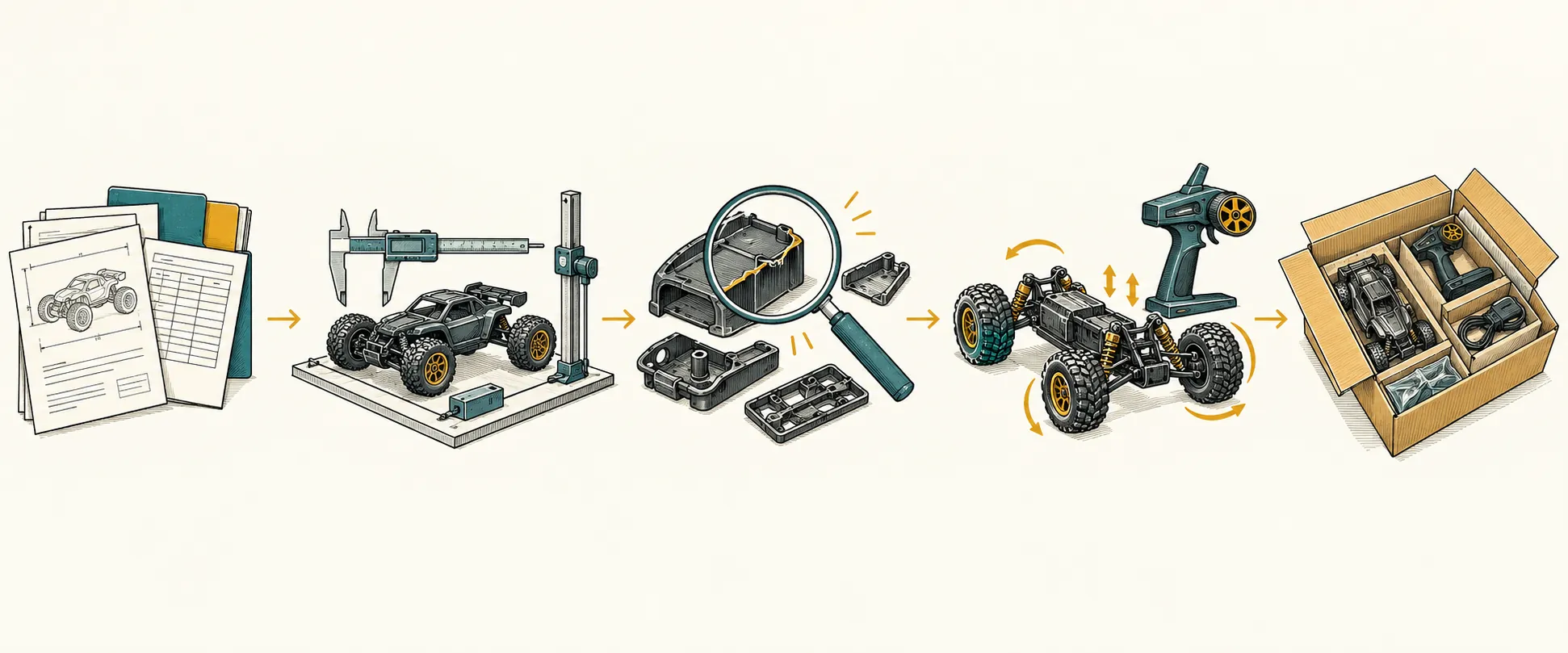
Keep the 1:16 gyroscope stunt car and 1:26 double-sided flip car as separate order lines, with unresolved options tied to each model’s intended play function and a release decision. In an RC vehicle sourcing order, record every open choice against a named specification revision, then assign an owner, closure evidence and deadline. Hold approval where the choice affects the assortment promise; approve with conditions only where remaining items cannot change the accepted product, pack or purchase terms.

Which product differences should anchor the unresolved-options record?
| Line A — 1:16 gyroscope stunt car | Catalog description: 1:16 scale, gyroscope stunt RC car, 2.4G, 4WD and off-road positioning. Proposed assortment role: the gyroscope-stunt option. Record the exact motion the buyer expects and how the supplier operates it; do not translate “gyroscope” into an unconfirmed stabilization or self-balancing specification. |
|---|---|
| Line B — 1:26 double-sided flip car | Catalog description: 1:26 scale, 2.4GHz, 4WD, off-road stunt car, double-sided operation, 360-degree flips, LED and charger included, described as ready-to-go. Proposed assortment role: the double-sided flip-and-light option. Define the required driving and flip demonstration, then reconcile the included charging equipment and other contents. |
| Shared wording — high speed and off-road | Both descriptions use high-speed and off-road positioning. Do not convert those terms into a numerical speed or terrain-performance commitment without an agreed target and supporting observation. |
How should confirmed entries and unresolved options be separated?
Use three statuses—confirmed, unresolved and not applicable—and state what each confirmation actually covers. “Confirmed: catalog entry” means the description has been captured correctly; it does not mean the sample, purchase terms or destination review has been approved.
Write each open item as a decision between defined alternatives, or as a precise request for a value. For example: “Confirm charger type and exact included contents” is actionable; “accessories TBD” is not. Beside the target, enter the supplier’s proposed value or the sample observation, with its document or sample revision.
Use “not applicable” only for a deliberately excluded option, with the reason and approving person recorded. A blank field is not an exclusion. Keep catalog baseline acceptance separate from the release effect of unresolved items.
What does a completed unresolved-options worksheet look like?
| BASE-A | Line A | Product baseline | Confirmed—catalog entry | Target: preserve the 1:16 gyroscope-stunt selection with 2.4G and 4WD. Recorded observation: these attributes appear in the catalog description; no sample acceptance is implied. Owner: sourcing buyer. Due: October 27, 2026. Closure record: dated catalog capture linked to order revision A. Order effect: baseline recorded; mechanism acceptance remains open under A-01. |
|---|---|
| BASE-B | Line B | Product baseline | Confirmed—catalog entry | Target: preserve the 1:26 double-sided flip selection, with 2.4GHz, 4WD, LED and charger included. Recorded observation: these attributes appear in the catalog description; “ready-to-go” remains subject to an exact contents agreement. Owner: sourcing buyer. Due: October 27, 2026. Closure record: dated catalog capture linked to order revision A. Order effect: baseline recorded; acceptance remains open under B-01 and P-02. |
| A-01 | Line A | Mechanism and sample | Unresolved | Target: an agreed demonstration defining what the gyroscope-stunt function does and how it is controlled. Observation to record: sample identity, demonstrated motion, control sequence and any departure from the target. Owner: product approval lead. Due: October 30, 2026. Closure evidence: signed sample review linked to the accepted specification revision. Order effect: blocks Line A product approval. |
| B-01 | Line B | Mechanism and sample | Unresolved | Target: agreed double-sided driving, 360-degree flip operation and LED function. Observation to record: results for each function on the identified sample, including any operating limitations. Owner: product approval lead. Due: October 30, 2026. Closure evidence: signed functional review and identified sample, with supporting video where useful. Order effect: blocks Line B product approval. |
| P-01 | Both lines | Materials and construction | Unresolved | Request: identify the principal body, chassis and tire materials separately for each model, and reconcile them with the proposed construction. Observation to record: supplier specification revision and sample differences. Owner: product engineer. Due: October 30, 2026. Closure evidence: accepted construction specification linked to each sample. Order effect: blocks specification freeze; a single material label must not stand for the entire vehicle. |
| P-02 | Both lines | Power and included contents | Unresolved | Request: list the vehicle battery arrangement, controller power requirements, charging equipment and every included accessory for each line; explicitly reconcile Line B’s charger-included and ready-to-go wording. Observation to record: proposed contents versus inspected sample contents and operating instructions. Owner: product approval lead. Due: October 30, 2026. Closure evidence: accepted contents list and sample review. Order effect: blocks contents approval and related packaging claims. |
| CTF-01 | Both lines | Packaging | Unresolved | Request: propose the retail pack, packed dimensions and weight, carton dimensions, carton weight and units per carton for each line; show how the vehicle, controller and charging accessories are retained. Observation to record: proposed packing revision versus the packed sample. Owner: packaging coordinator. Due: November 2, 2026. Closure evidence: approved packing specification, contents reconciliation and packed-sample record. Order effect: blocks packing approval and freight-volume confirmation. |
| C-01 | Both lines | Commercial terms | Unresolved | Request: provide a current quotation stating the selected configuration, quantity, minimum order quantity, price, inclusions and agreed delivery basis. Observation to record: quoted terms against the buyer’s proposed order. Owner: sourcing buyer. Due: November 2, 2026. Closure evidence: accepted quotation linked to the same product and packing revisions. Order effect: blocks purchase commitment. |
| D-01 | Both lines | Age, destination and documents | Unresolved | Request: state the intended destination and proposed age positioning, then obtain a qualified review of the documents, instructions and markings for the selected construction. Observation to record: reviewer’s acceptance or specific conditions, with document references. Owner: importer compliance lead. Due: November 2, 2026. Closure evidence: documented review with outstanding actions explicitly closed or assigned to a later release gate. Order effect: blocks final order approval in this example; catalog wording is not document acceptance. |
Which unresolved options should block the order?
Block the relevant approval when an unresolved option could change why the buyer selected the vehicle, what the customer receives or what the buyer commits to purchasing. In this example, an unexplained gyroscope function blocks Line A; an unaccepted double-sided flip demonstration blocks Line B. An undecided charger or battery arrangement also affects contents and packaging, rather than being a minor accessory note.
Name the gate precisely: sample acceptance, specification freeze, purchase commitment or shipment release. “Non-blocking for sample review” must not silently become “non-blocking for shipment.” An optional internal filing task can remain open after approval if the accepted evidence is already identifiable and accessible; an undecided product function cannot.
Hold a line while an acceptable answer is still being developed. Reject the proposed configuration when the buyer decides it does not meet the required assortment role, or declines to proceed under the offered conditions. An unanswered request alone does not establish that the supplier cannot meet it.
Where the two lines are commercially separable, record a line-level decision. Do not release both automatically because one sample passed, or hold an otherwise acceptable line without recording the shared dependency.
What should the one-line order decision record say?
The decision record should identify the order and revision, the covered lines, the approval scope, the decision maker and date, and the exact conditions for changing the decision.
For the illustrative worksheet: “RC-OPTIONS / Rev A | Lines A and B, catalog baselines accepted for review only | HOLD purchase commitment | Approver: import purchasing manager | Decision date: October 27, 2026 | Open: A-01 and B-01—product approval lead, October 30; P-01—product engineer, October 30; P-02—product approval lead, October 30; CTF-01—packaging coordinator, November 2; C-01—sourcing buyer, November 2; D-01—importer compliance lead, November 2 | Release only after the approver accepts the linked closure evidence and issues the accepted order revision.”
At closure, retain the original request and append the accepted value, observation, evidence reference, reviewer and closure date. Record any change to the product, pack, price or release conditions in the next order revision, then have the responsible approver sign and date the new decision. An evidence attachment is not closure until someone accepts it against the stated target.
This record supports traceability and handoff. It does not by itself prevent or reveal an undisclosed substitution.