Request RC failure analysis by describing the observed behavior, identifying the exact vehicle sample and revision, and asking the investigator to test competing explanations—not confirm your preferred cause. Before sending the request, have the buyer’s decision owner approve the evidence package, investigation scope, required report, and stop conditions. Keep the affected sample-to-order approval or corrective-action decision on hold until the findings support a disposition or the owner authorizes a documented next step.
For a ground RC vehicle, “steering responds but the vehicle does not move forward” is a symptom. “The drive motor is defective” is a proposed explanation. Keep those statements separate throughout the request.
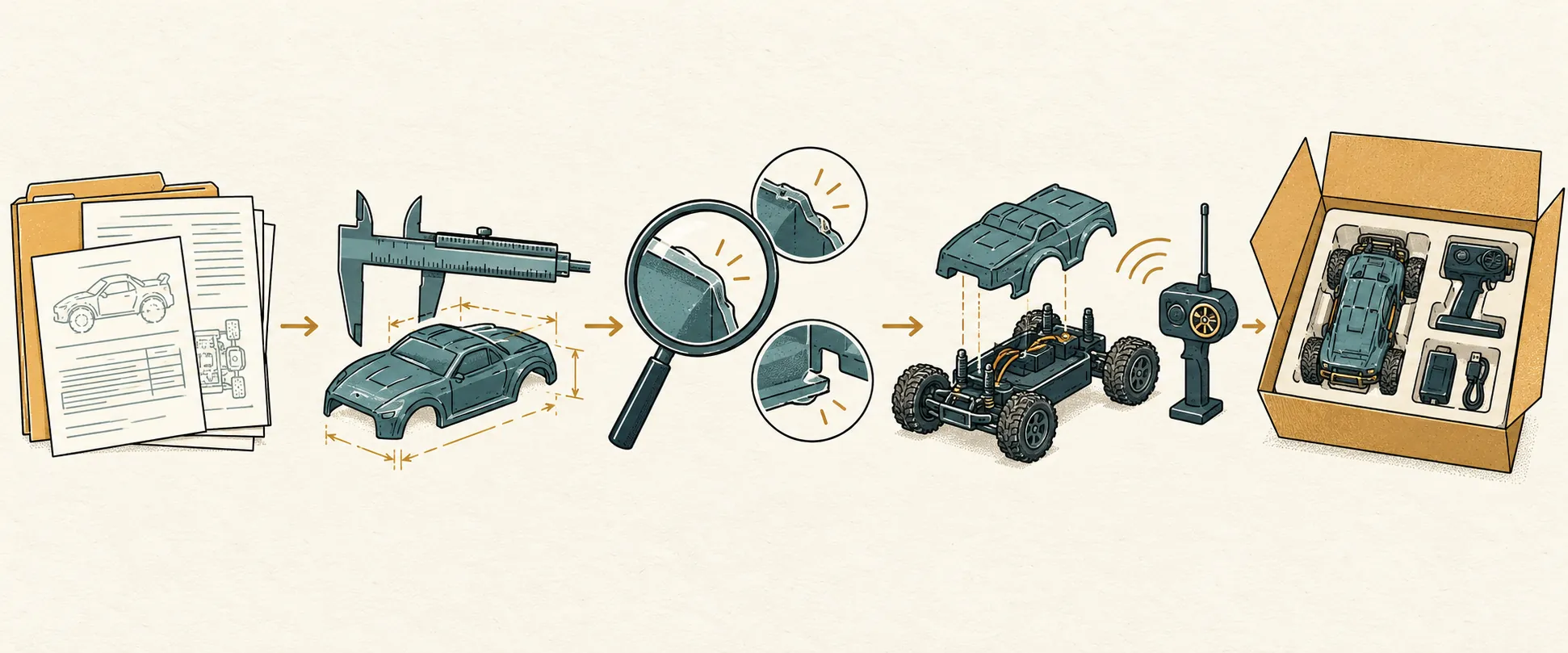
Who should approve the RC failure-analysis request, and in what sequence?
Assign one buyer-side product manager or technical buyer to authorize the investigation and own the resulting order decision; assign a technical reviewer to assess whether the proposed work and findings answer the failure question.
Use this purchasing sequence: preserve the sample and collect the evidence; send the supplier or laboratory a preliminary scope; obtain its proposed methods, handling instructions, commercial terms, and decision gates; then approve the investigation authorization. Agree on sample receipt before dispatch. Authorizing analysis is separate from approving a repair, accepting a cause, or releasing an order.
Choose the supplier for an initial investigation when access to the vehicle’s construction and assembly records is central to the question. Select an independent laboratory when the question requires specialist analysis or an independent assessment. In either case, require a named investigation lead and agreement on the report contents before work starts.
Your ongoing job is to preserve evidence across samples and returns. The immediate decision is narrower: whether this request, for this identified unit and configuration, is ready to send. An unresolved cause is not a reason to delay commissioning an investigation; uncertainty about which unit is being investigated may restrict what that investigation can establish.
What belongs in the symptom-evidence and authorization table?
| Case identity and request revision | Assign a case reference, request revision, issue date, supplier or laboratory recipient, and buyer contact. Link every attachment and subsequent report to this case. |
|---|---|
| Vehicle and sample identification | Record the product name, buyer and supplier item references, unique physical sample ID, batch or date markings, and specified revision. Photograph labels and markings. Distinguish a documented revision from one inferred from appearance. |
| Configuration received | Identify the vehicle, transmitter, battery, charger, and accessories supplied for analysis. Record repairs, substitutions, disassembly, resets, or other interventions already performed. Photograph the received condition before further changes. |
| Specified target versus observation | Cite the approved specification, operating instruction, or sample requirement and its revision. Separately describe what occurred. If the target behavior is disputed, ask the investigator to resolve that comparison before declaring a failure. |
| Failure event and operating conditions | Record the event date, location, operator or reporter, command sequence, surface, load, approximate distance, and environmental conditions relevant to the symptom. Separate measured conditions from recollections. |
| Battery and charger evidence | Identify the battery and charger used, reported charging history, indicator behavior, and any available measurements with their method and date. Do not treat a charge indicator alone as proof that the power supply performed correctly during the event. |
| Symptom and reproduction history | Describe visible or audible behavior and the sequence immediately before and after it. List attempted reproductions and their conditions, including attempts where the symptom did not occur. |
| Affected quantity and comparison group | Record affected units against the defined group inspected or used, identifying the period and selection method. Distinguish returned units from inspected units; do not present a convenience sample as an order-wide failure rate. |
| Evidence register and statement status | List original photo, video, log, and correspondence references. For each material statement, record Confirmed, Assumed, or Unresolved; the evidence reference; and the responsible person for any follow-up check. |
| Investigation scope and restrictions | State the questions to answer, permitted initial work, sample-preservation requirements, and which actions require further authorization. Identify any known damage, contamination, leakage, or other handling concern before arranging shipment. |
| Required deliverable and work authorization | Specify a revision-controlled report, supporting evidence, sample disposition, and the next review point. Record the approved scope, commercial authorization reference, buyer decision owner, technical reviewer, approval date, and any conditions. |
| Follow-up and closure | Reserve a decision entry for proceed, rework, or hold, with rationale and conditions. Assign each follow-up action an owner and agreed completion date, then record closure evidence, approver, and closure date. |
How do you turn an RC symptom into neutral investigation questions?
| Instead of: “Confirm the motor is defective.” | Request: “Can the reported loss of forward motion be reproduced in the received configuration? Record the command sequence, setup, observed response, and any differences from the buyer’s evidence.” This establishes the symptom before assigning a cause. |
|---|---|
| Instead of: “The lights work, so the battery is good.” | Request: “What checks would establish whether the power supply remains suitable during the attempted drive command?” Keep indicator behavior separate from evidence about performance under the relevant operating condition. |
| Instead of: “Replace the control board and see if that fixes it.” | Request: “Which observations or tests would distinguish a control-path issue from a motor or mechanical-drive issue before parts are replaced?” Require authorization for substitutions and preserve the original parts. |
| Instead of: “This batch has a drive defect.” | Request: “What evidence links the investigated unit to other affected units, and what comparison samples or records would be needed to assess shared scope?” A finding on the submitted unit does not by itself establish a batch-wide cause. |
What limits should the buyer place on the investigation?
Authorize work in stages so the investigator can gather evidence without silently changing the sample or exceeding the agreed scope.
Start with received-condition documentation, record review, and suitable non-destructive checks. Ask the investigator to propose any powered reproduction work and its precautions. Do not repeatedly operate or charge a unit showing overheating, swelling, leakage, smoke, or damaged wiring; stop use and obtain competent handling instructions.
Require a separate approval gate before destructive examination, firmware changes, rework, or component substitution that could alter relevant evidence. The proposal should identify the question being answered, why the step is needed, what evidence it may consume, and what will be retained. Avoid demanding a particular laboratory technique merely because it sounds thorough.
Set a commercial review point as well: the investigator should stop and seek approval when the next step falls outside the authorized work or spending limit. Preserving configuration records supports traceability, but a record alone does not establish that every change has been disclosed.
What must the failure-analysis report answer?
Require a report that connects each conclusion to the identified sample, investigation method, and supporting evidence, while stating what remains unresolved.
The report should carry its own reference, revision, date, author, and sample receipt record. It should identify the configuration examined, compare the specified target with the observed behavior, and document the setup, methods, sequence of work, substitutions, and departures from the approved scope.
For each investigation question, require the finding, evidence references, competing explanations considered, and limitations. A failed component may be the immediate failure location without explaining why it failed. Ask the investigator to distinguish the observed failure mechanism from a proposed underlying cause and to state what supports that distinction.
Allow a documented inconclusive result. “Symptom not reproduced under the stated conditions” is different from “no defect exists.” Likewise, improvement after replacing a part can guide further work without proving why the original condition occurred.
Any corrective-action recommendation should identify the evidence supporting it, the affected scope it addresses, and the proposed verification needed before closure. Require the report to state the condition and disposition of the submitted unit and retained parts. Failure analysis does not, by itself, establish safety compliance or performance across the whole order.
When should the buyer hold, escalate, or close the request?
Hold the affected approval whenever the evidence does not support the proposed decision, and record a specific next action rather than ordering a guessed fix.
Before dispatch, stop if handling concerns have not been addressed or the recipient has not agreed to receive the sample. If sample identity is uncertain, resolve it where possible; otherwise explicitly restrict the investigation to the submitted unit rather than presenting its findings as evidence about a particular revision or batch. Missing traceability limits those conclusions but does not erase other valid observations.
During analysis, pause at an unapproved destructive step, a new handling concern, or the agreed commercial boundary. An inconclusive report should trigger a defined choice: obtain additional evidence, approve a revised scope, or close the investigation as inconclusive while retaining the relevant order hold. Do not relabel uncertainty as a confirmed cause to finish the paperwork.
In the RC vehicle sample-to-order workflow, proceed only when the findings and completed conditions support the affected approval. Authorize rework when the proposed change has an evidence-based rationale and an agreed verification plan. Keep the decision on hold when the remaining uncertainty could change the disposition.
Close the case with the buyer decision owner’s name, decision date, reviewed report revision, rationale, and any remaining restrictions. For conditional approval, name the person responsible for each follow-up and require closure evidence and dated sign-off. A promise to investigate later is not closure.