Accept existing RC coating and material test evidence only when you can link the current production configuration to the tested materials and the intended destination’s applicable requirements. If a resin, pigment, coating, adhesive, or relevant process changes, request a documented applicability assessment before approval; require retesting where that assessment identifies testing needs. The practical tool is a material-to-report register that records the tested baseline, current specification, observed differences, and a dated accept, review, or retest decision.
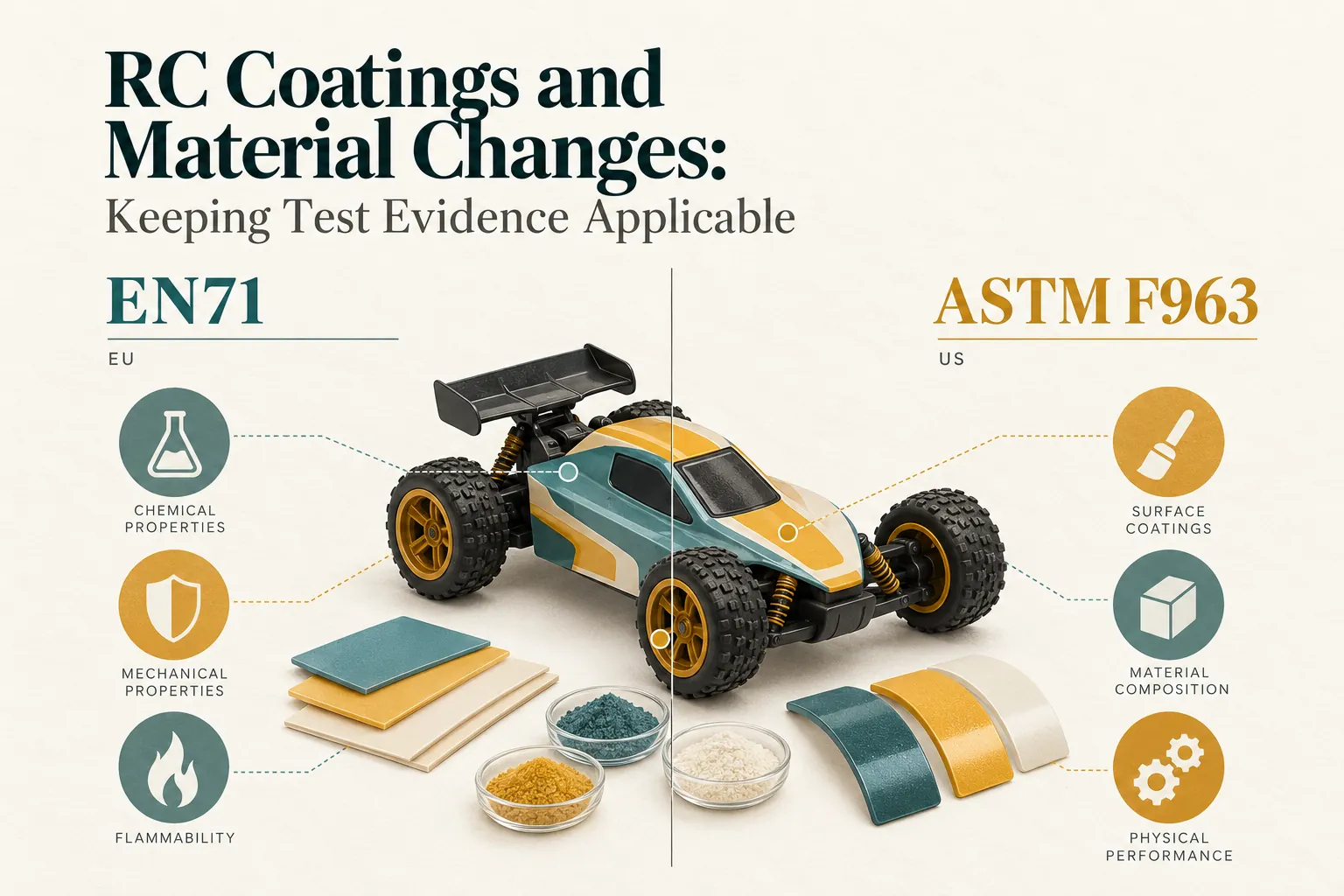
What makes a report applicable to the RC materials being supplied?
A report is applicable only within its documented scope: the identified specimen, materials or assembly, test methods, and configuration must support the configuration you intend to approve. A matching product name or a photograph of the same body shape is not enough to establish that link.
Check the model and revision, specimen photographs, part descriptions, material identities, components, and intended age classification against the supporting records. Watchdog Compliance’s October 25, 2026 guidance recommends these product-to-report checks and reassessing existing testing after design, material, or production-process changes. This is purchasing guidance from an Australian consultancy, not a determination of US or EU legal requirements. Watchdog Compliance
Report age and applicability are different questions. A February 1, 2012 ASTM symposium paper discusses continued applicability of fire-test reports by comparing both the offered item and the required test method with what was tested. That provides a limited methodological analogy—not an RC-toy testing rule or a universal report-expiry policy. ASTM symposium paper
For each destination, have the responsible technical reviewer confirm the product classification, intended age group, relevant requirements, and applicable method editions. Record effective or transition dates where they affect the assessment. Keep US and EU conclusions separate when their evidence requirements differ; an unchanged coating does not, by itself, establish that one destination’s report supports another.
What belongs in a material-to-report linkage table?
| Product and destination identity | Record the buyer’s model identifier, product revision, bill-of-materials revision, destination, intended age group, and classification used for the assessment. |
|---|---|
| Part and material location | Identify the part and surface: for example, body-shell substrate, exterior paint layer, printed decoration, tire material, or adhesive joint. Record whether the evidence addresses the material alone or its use in the assembly. |
| Approved material target | Enter the approved manufacturer, grade or controlled formulation reference, colorant reference, coating system, and material-specification revision as relevant. Link the approved sample and supporting material documents. |
| Current configuration and observations | Record the materials declared for current production, their revisions, the sample or production lot examined, and the evidence used to compare them with the approved target. Distinguish supplier declarations from sample observations. |
| Report identity and specimen linkage | Enter the issuing laboratory, report number, issue date, revision or amendment, specimen identifier, and relevant page or sample reference. Attach the records connecting the tested specimen to the material and part. |
| Tested configuration and coverage | Describe the tested material, color or formulation, substrate, coating layers, and assembly state to the extent relevant to the test. Identify whether the report covers a component, a material sample, or a finished RC product. |
| Method and destination assessment | Record the test method and edition, relevant test scope, destination requirement being assessed, and the reviewer’s applicability rationale. Keep separate conclusions for different test endpoints. |
| Change and disposition link | Reference the change notice, affected reports, accept/review/retest status, decision record, responsible reviewer, and any open approval conditions. |
Which coating and material changes trigger an applicability review?
| Resin, additive, or material substitution | Compare the old and proposed resin grade, plasticizer, filler, recycled-content specification, or other formulation reference. Identify which existing conclusions relied on the original material before deciding what additional evidence or testing is needed. |
|---|---|
| Pigment, paint, ink, or adhesive change | Review colorant formulation, coating product, printed decoration, clearcoat, or adhesive changes even when the visible color and product name remain unchanged. Do not extend a report to another formulation solely because the finish looks similar. |
| Supplier or manufacturing-source change | Confirm whether the new source supplies the same controlled material and process specification. A new supplier name alone does not prove a material difference, but an “equivalent” description alone does not demonstrate equivalence either. |
| Coating-process change | Assess changes to layer sequence, application specification, curing conditions, surface preparation, or production location where they could affect the tested construction. Compare the relevant process records with the tested baseline. |
| Part design or material-accessibility change | Check whether a revised substrate, part geometry, coated area, or assembly makes a previously covered material assessment insufficient. Keep the review focused on the affected coating, material, and relevant tests. |
| Destination, classification, or requirement change | Ask the qualified reviewer to assess the new destination, intended age classification, or applicable requirement and method edition. Document whether existing results remain usable and which additional evidence is needed. |
How should a buyer assess an unchanged finish versus a new clearcoat?
| Case A: The model name changes, but the controlled construction does not | The supplier provides a documented cross-reference from the new model name to the same body-shell revision, material references, paint specification, and tested specimen. If the destination assessment and relevant evidence remain applicable, accept the existing report for its documented scope and retain the cross-reference. Renaming alone does not establish a need for retesting. |
|---|---|
| Case B: The model name stays the same, but a clearcoat is added | The added layer changes the coating system despite the unchanged model name. Mark the affected evidence for review, obtain the clearcoat identity and revised layer/process specification, and have the reviewer determine which chemical or other relevant assessments are affected. Do not treat the single-layer report as proof of coverage for the added clearcoat. |
| Possible resolution of Case B | Accept existing evidence only where a documented assessment supports its continued use. Where testing is needed to establish coverage of the revised system, define that test scope and keep approval of the revised coating configuration pending until the required evidence is reviewed and linked. |
When should the buyer accept, review, or require retesting?
Accept when traceable records establish that the current configuration is covered by the relevant evidence and the destination assessment supports that use. Record acceptance by report and test scope rather than giving the whole product an unrestricted “covered” status.
Choose review when a change is identified or the connection between the current material and tested specimen needs clarification. Request specific evidence: a controlled formulation cross-reference, revised coating specification, specimen-identification record, or written technical assessment. Missing linkage does not prove a material has changed or failed testing.
Require retesting when the applicability assessment identifies tests needed for the changed configuration. Define the affected material, specimen construction, and test scope with the laboratory or qualified reviewer; do not default to repeating every test. Document the retest decision even when the product name and internal item number remain unchanged.
What must the approval record contain before conditions are closed?
| Record identity and revision | Assign a decision-record reference and revision; identify the product, destination, material-linkage records, and change notice assessed. |
|---|---|
| Specified target versus observed configuration | State the approved material/process baseline, the proposed or observed difference, and the documents or samples used to establish that difference. |
| Decision, rationale, and boundaries | Record accept, review, or retest; identify each report and revision assessed; explain the affected test scopes, retained evidence, and limits of the decision. |
| Responsible approval and date | Name the technical assessor and authorized approver, record their decision dates, and assign an owner and due date for each outstanding condition. |
| Follow-up and closure evidence | Attach the required assessment, revised report, sample-verification record, or other agreed evidence. Record who reviewed it, the closure date, and the final approved product/BOM revision. |
What does this linkage record establish—and what does it not?
A completed linkage record supports a traceable applicability decision for the materials, configuration, destination, and test scopes it identifies; it is not a compliance certificate or a guarantee covering the entire RC product. Document control also cannot, by itself, detect an undisclosed substitution. Pair the record with controlled change notification and relevant sample or production checks, while keeping those commercial checks distinct from safety testing.