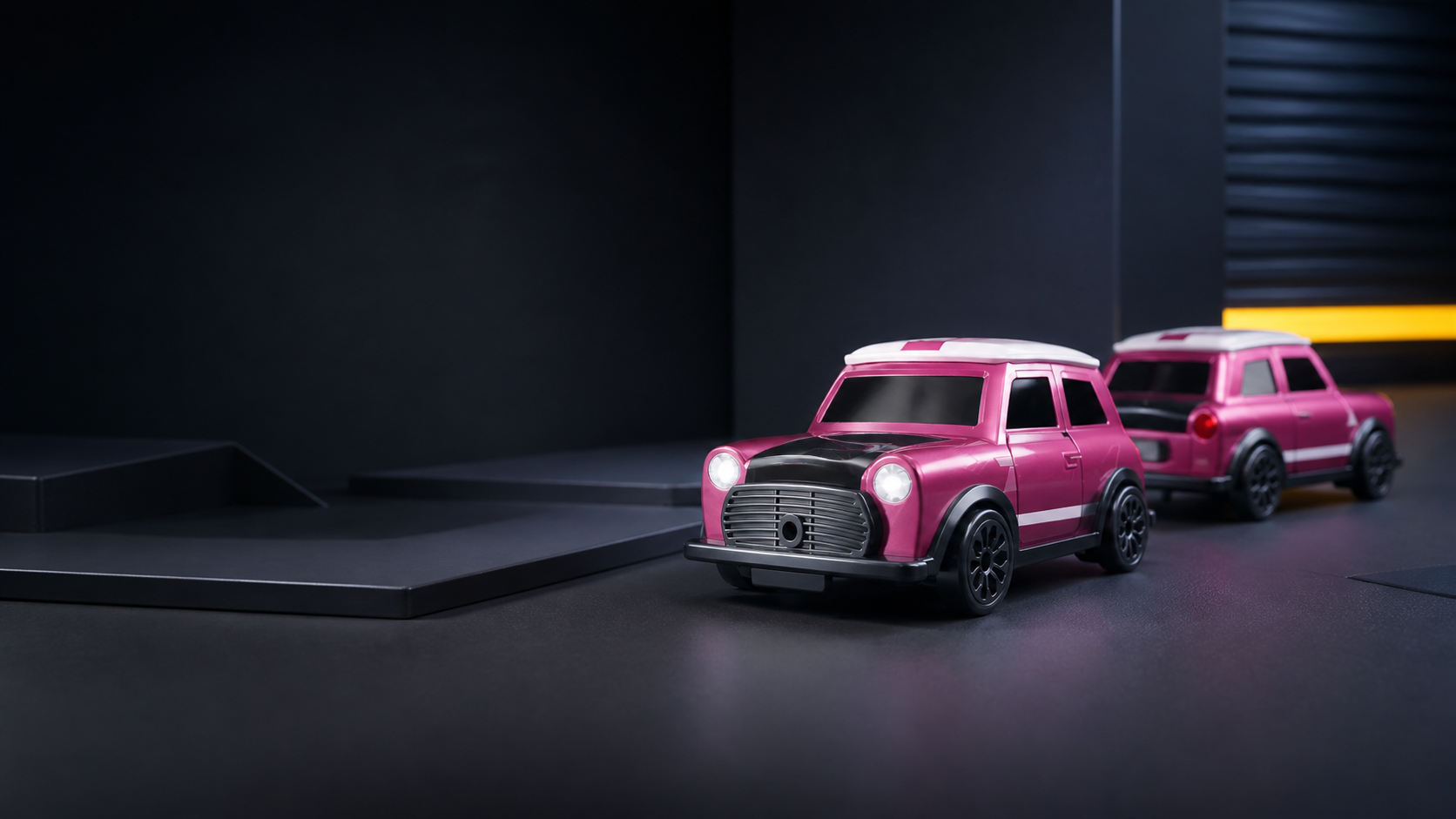
Select RC drift cars for a smooth-floor assortment only when the intended floor and controllable turning behavior are supported separately; a “drift” name or 360-degree spin claim is not enough. Hold plausible candidates for a defined sample check, include those that meet the agreed surface and handling targets, and exclude those that fail those targets or fall outside the brief. Treat catalog features as documented claims, not as measured compatibility or turning results.
Which smooth-floor surface must the car actually match?
Specify the floor material, finish and condition before judging compatibility: hardwood, vinyl, laminate, clean tile and smooth concrete are separate targets, not interchangeable evidence.
The D24-03S seller recommends hardwood, vinyl, laminate, clean tile, smooth concrete and tabletop-style courses. The same seller warns that rough garage concrete, dust, sand, chipped paint and small bumps can make the car spin more easily. Those are product-specific recommendations and warnings, not measured results for every surface in those categories. D24-03S listing
Record the actual finish, joints, cleanliness and usable driving area. Treat dusty, gritty, chipped or uneven conditions as outside a clean smooth-floor brief unless separately evaluated. A tabletop description also needs a defined surface material and usable area; it does not establish that every tabletop is suitable.
For the worked comparison below, the proposed buying target is a clean laminate indoor course. The required behavior is a controlled sliding arc and a left-to-right transition within a buyer-marked boundary—not merely rotation in place.
Which candidates advance in a clean-laminate evidence matrix?
| D24-03S indoor drift car | SKU/model: D24-03S; confirm the orderable variant. Scale: C—1:24. Drivetrain: C—4WD. Tire compound and included tire sets: C—seller lists drift tires plus rubber racing tires; U—exact drift-tire compound and fitted sample set. Stated surface recommendation: C—hardwood, vinyl, laminate, clean tile, smooth concrete and tabletop-style courses. Evidence source: D24-03S seller listing. Intended surface match: C—laminate is explicitly named; A—the recommendation transfers to the buyer's exact finish and course. Turning-behavior evidence: C—seller describes proportional steering and adjustable gyro support; tuning advice is qualitative, not a measured result. Evidence status: C—listed features and recommendation; A—application to the exact course; U—sample compatibility and handling. Required sample check: identify tire compound and supplied sets, verify proportional steering and gyro adjustment, then observe sliding arcs, transitions, recovery and floor marking on the target laminate. Decision: HOLD—first candidate to sample for this brief. |
|---|---|
| CTF-4 Sport 3 Fun Haver Mustang V2 drift car | SKU/model: HPI 120094, CTF-4 Sport 3 Fun Haver Mustang V2 RTR. Scale: C—1:10. Drivetrain: C—shaft-driven 4WD. Tire compound and included tire sets: C—hard-compound drift tires are listed; U—additional included sets and exact compound specification. Stated surface recommendation: C—pavement and smooth concrete. Evidence source: CTF-4 Sport 3 seller listing. Intended surface match: U—laminate is not established by the supplied recommendation; do not infer suitability or unsuitability from that omission. Turning-behavior evidence: C—seller describes forgiving handling and consistent sliding qualitatively; U—steering proportionality, gyro presence and adjustability, and measured turning behavior. Evidence status: C—listed features and recommended surfaces; U—laminate compatibility and handling on the proposed course. Required sample check: identify included tire sets and steering/gyro configuration; evaluate course space, sliding arcs, transitions, recovery and floor marking on the exact laminate finish. Decision: HOLD for the laminate brief; reconsider its documented recommendation separately for a smooth-concrete brief. |
| 2.4G 4WD gesture-controlled twist stunt car | SKU/model: CTF-1600992289661. Scale: U—not established in the supplied record. Drivetrain: C—catalog title states 4WD; sample verification remains open. Tire compound and included tire sets: U—not established in the supplied record. Stated surface recommendation: U—no laminate recommendation established; off-road and drift wording in the title is not a compatibility result. Evidence source: [[link:https://cartoyfactory.com/2-4g-4wd-stunt-rc-CTF-360-hand-wholesale/|current-site catalog record]], supplied snapshot dated 2026-10-09. Intended surface match: A—the drift wording may be relevant to the brief; U—actual laminate suitability. Turning-behavior evidence: C—catalog names gesture control and 360-degree stunt/drift positioning; U—steering architecture, proportionality, gyro function and controlled sliding behavior. Evidence status: C—catalog identity and stated features only; A—relevance to controlled drifting; U—surface and handling suitability. Required sample check: confirm scale and dimensions, tire construction and supplied sets, intended surfaces, steering architecture and any gyro function; then demonstrate arcs, transitions and recovery within the marked laminate course and inspect for floor marking. Decision: HOLD—not a first-choice controlled-drift candidate on the name alone; stunt rotation does not satisfy the sliding-path target. |
What turning behavior separates a drift candidate from a spinning stunt car?
A controlled-drift candidate must demonstrate a sliding path that the operator can maintain and redirect; a stationary spin, flip or rolling stunt does not answer that requirement.
Capture drivetrain configuration, steering architecture and proportionality, gyro presence and adjustability, and the fitted tire setup. Record reported handling separately from observations. A catalog establishes what is described for sale; it neither proves behavior across all smooth floors nor creates an industry compatibility standard.
Use gyro settings as test variables, not as a pass badge. The D24-03S seller advises starting around a medium setting: higher assistance can make the car easier to catch, while excessive assistance may reduce drift angle; lower assistance allows freer rotation but requires quicker steering correction. This is qualitative tuning guidance, not a measured comparison. D24-03S listing
For sample screening, mark a course boundary on the intended floor and use the supplied tires first. Observe a steady curve in each direction, a left-to-right transition and recovery after a steering correction. Where adjustments exist, change one setting at a time and record it. Separate the low-speed steering envelope from the space occupied during a sliding turn; they answer different questions.
Agree the acceptable course boundary, control behavior and floor-marking criteria before testing. These are proposed purchasing criteria, not compliance standards. A high-grip tire result must not be substituted for the drift-tire result, and a different floor finish needs its own observation.
When should a candidate be included, held or excluded?
Include a candidate when evidence addresses the intended surface and the sampled configuration meets the agreed turning targets; hold it while a consequential check remains open; exclude it when it falls outside the brief or fails the agreed criteria.
For the clean-laminate example, the D24-03S has the clearest documented surface match, but still needs handling verification. The CTF-4 candidate's pavement and smooth-concrete recommendation is not a reason to declare it unsuitable for laminate; it is a reason not to approve that application without checking it. The gesture-controlled stunt car remains a category-boundary question until its sample demonstrates controlled sliding rather than only stunt rotation.
Use exclusion precisely. A demonstrated inability to stay within the agreed course, unacceptable floor marking, or a control scheme that cannot deliver the required transitions can justify exclusion from this assortment. If a necessary check cannot close by the assortment freeze date, exclude the candidate from that release—not from every future application.
Do not force an “include” result to fill an assortment slot. A hold is a useful decision when it names the exact check that will change it.
What must close before the assortment is finalized?
Close each hold with a traceable sample result, a recorded decision and a responsible approver—not merely a completed feature list.
Attach the product and variant identity, sample ID, configuration revision, catalog reference and review date to each matrix row. For every consequential check, record the specified target beside the actual observation, including floor finish, tires, steering mode, gyro setting where applicable and course boundary. Keep an observation such as “transition crossed the marked boundary” separate from the target “remain inside the marked boundary.”
Assign a named owner and due date to each open check. Record the final include, hold or exclude decision, any conditions, the approver and approval date, and the follow-up result and closure date. An inclusion condition should identify the tested configuration and approved floor application rather than simply say “smooth-floor suitable.”
This record supports traceability. It does not by itself detect an undisclosed tire, control or construction change; identify configuration changes and review whether the affected surface or handling check needs repeating.